August 29, 2026

When AI systems write code and other AI systems review it, the quality assurance function does not disappear—it shifts. The team's responsibility moves from finding bugs in human-written code to verifying that AI-generated code meets the actual requirements of the system under test, and that the AI reviewer did not pass code that is correct in structure but wrong in behavior. QA engineers who adapt to this shift own one of the most valuable functions in the modern software team: they are the humans who know what the software is supposed to do, and who can test whether it actually does it regardless of how the code was produced.
The primary change is in where defects originate. In a traditional workflow, bugs are introduced by human developers writing code, and the code review process catches logical errors, style inconsistencies, and missed cases. When AI generates code, the failure modes shift: the AI may produce syntactically valid, linting-passing code that is structurally sound but functionally wrong—it implements the described interface correctly but handles edge cases incorrectly, or it produces code that passes all existing tests but violates an unstated assumption about system behavior.
AI code reviewers compound this pattern. An AI reviewer evaluates the code it receives against patterns it has learned, not against a running system. It can confirm that the code matches the style guide, catches common antipatterns, and matches the described intent of the pull request. What it cannot do is run the code against the application's full state, confirm that it integrates correctly with adjacent services, or verify that the user-facing behavior matches the product specification.
This creates a gap that QA must fill. The question is not whether the AI reviewer was thorough—it is whether the software works as intended in a production-like environment, with real data, real user flows, and real integrations. This is precisely where structured software testing services add value that no AI reviewer can replicate.
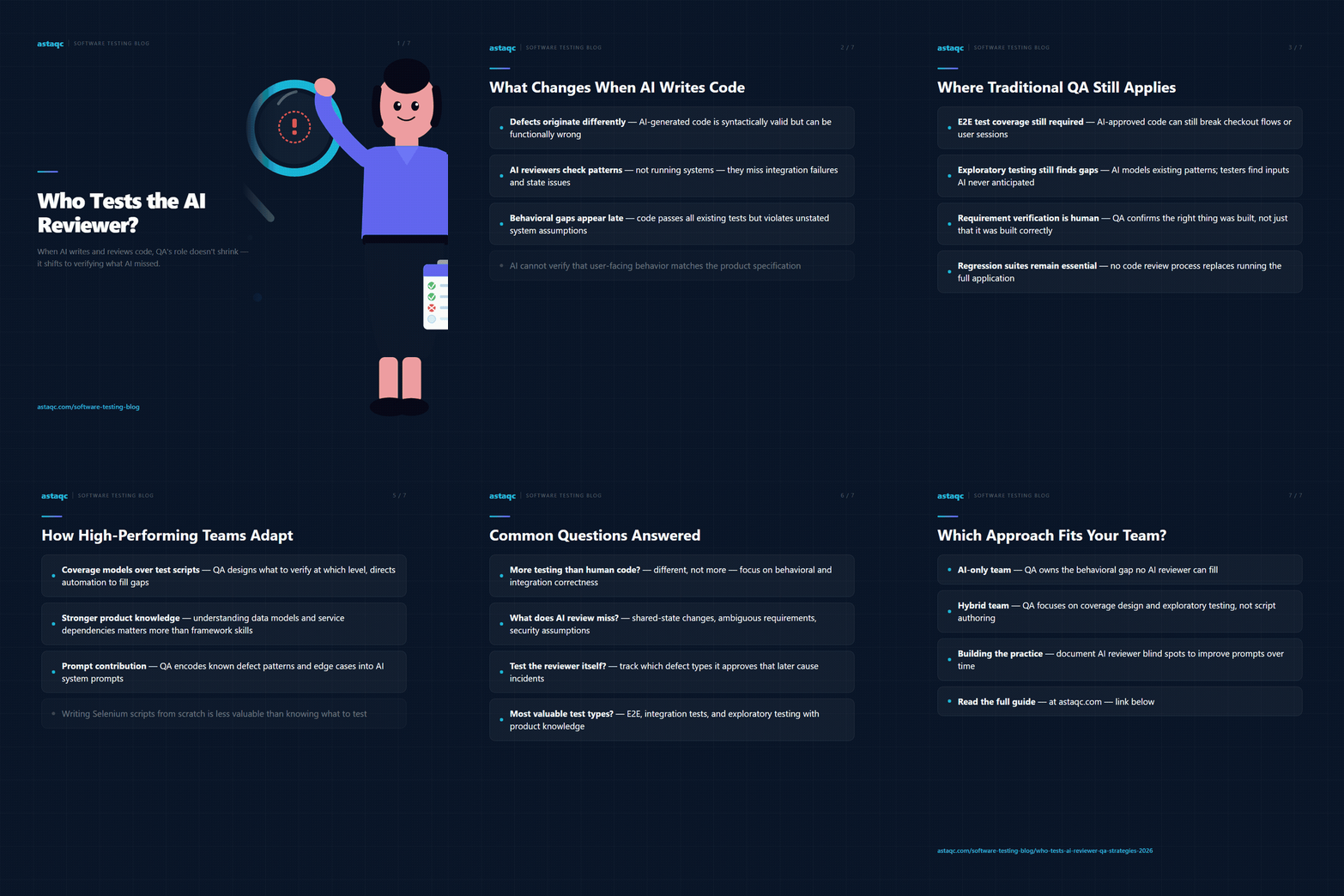
Several QA responsibilities remain unchanged regardless of how code is produced. End-to-end test coverage of user-facing flows is still required. AI-generated code that passes unit tests and passes AI review can still break a checkout flow, corrupt a user session, or fail on a specific browser. Automated regression suites that run against the full application provide coverage that no code review process—human or AI—can replace.
Exploratory testing still finds issues that structured test suites miss. A QA engineer navigating the application as an unfamiliar user, trying unexpected inputs, and looking for behavioral inconsistencies will find defects that no automated test anticipated. AI-generated code is particularly prone to gaps in edge case handling because the AI models behavior from existing patterns, which may not include the full range of inputs a real user will attempt.
Requirement verification remains a human function. QA engineers read the specification, understand the intent, and determine whether the software does what was requested. An AI reviewer can confirm that code matches the described approach in the pull request, but it cannot independently confirm whether the pull request itself was the right thing to build. That judgment belongs to humans who understand the product. For teams building out these practices, Astaqc's manual testing capabilities provide structured QA support alongside automated coverage, and our complete guide to software testing covers foundational principles that remain relevant regardless of how code is produced.
QA teams testing AI-generated code benefit from organizing their verification into distinct categories, each targeting a different type of failure that AI code generation and review tends to introduce:
| Verification Category | What to Check | Method |
|---|---|---|
| Behavioral correctness | Does the code do what the requirement says? | E2E tests against acceptance criteria |
| Edge case coverage | What happens with empty, null, or unexpected inputs? | Exploratory testing and parameterized unit tests |
| Integration correctness | Does it work with adjacent services and real data? | Integration tests in a staging environment |
| Regression impact | Did this change break existing functionality? | Automated regression suite |
| Security surface | Did AI introduce new input vectors or authentication gaps? | SAST scan and manual review of new endpoints |
| AI reviewer gaps | What did the AI review miss or approve incorrectly? | Human review of changes the AI approved without flagging |
The last category—identifying what the AI reviewer missed—is a new QA responsibility. Teams building institutional knowledge about their AI reviewer's blind spots can calibrate how much additional scrutiny to apply to specific types of changes. AI reviewers tend to miss context-sensitive behavioral requirements, changes that involve state shared across multiple services, and cases where the correct behavior depends on historical data the AI has not seen.
QA engineers on teams using AI code generation and review are moving toward a role that is more analytical and less execution-focused. Instead of writing test cases for every function, they are designing test coverage models that identify which behaviors need verification at which level, and then directing automation to fill those gaps efficiently.
This means QA engineers need stronger product knowledge, not weaker technical skills. Understanding the application's data model, knowing how services depend on each other, and being able to read code well enough to identify suspicious patterns are all more valuable in an AI-assisted codebase than the ability to write Selenium scripts from scratch. The engineer who can ask what this code is supposed to do under these conditions and then write a test that answers that question is the one whose role expands in this environment.
Teams are also starting to include QA feedback in AI system prompts. When an engineering team documents common defect patterns, edge cases that have caused production incidents, and requirements that the AI reviewer has historically missed, they can encode that knowledge into the prompts used to guide both code generation and code review. QA engineers with institutional knowledge of the product's failure modes are well positioned to contribute to this process.
For guidance on building a testing strategy that accommodates AI-generated code, Astaqc's test automation services and testing documentation resources provide frameworks for coverage planning and risk-based testing. The guide to outsourcing software testing is also relevant for teams that want structured QA support without building the entire practice internally.
It needs different testing, not necessarily more or less. AI-generated code tends to be structurally consistent and stylistically clean, but it is more likely to miss edge cases, misinterpret ambiguous requirements, or produce behavior that is subtly wrong at integration boundaries. QA coverage should focus on behavioral correctness and integration correctness rather than basic syntax and style.
Common patterns include changes that affect shared state across services, requirements tied to edge cases not represented in the training context, and security assumptions the AI reviewer did not flag as risky. Teams should track post-incident reviews and note whether a given change was AI-generated and AI-reviewed to build calibrated institutional knowledge over time.
Understanding how to write effective prompts for code generation and how to evaluate AI output is increasingly useful for QA engineers, particularly for generating test scaffolding and test data. It is less critical than deep product knowledge and testing strategy, which remain the core skills that determine a QA engineer's effectiveness in an AI-assisted workflow.
By tracking which types of defects it approves that later cause incidents, and which types it flags that turn out to be false positives. Over time, this produces a calibration of the reviewer's accuracy by change type, which the team can use to decide where to apply additional human review on top of AI review.
E2E tests against user-facing flows, integration tests for service boundaries, and exploratory testing by QA engineers with product knowledge provide the highest signal. Unit tests remain valuable for isolated logic but are not a substitute for testing AI-generated code in a production-representative environment with real data and real service integrations.
The manual testing vs. automated testing guide and the AI in software testing guide both address how testing practices are evolving alongside AI tools in 2026. The software testing cost and pricing guide is useful for teams making investment decisions about QA staffing and tooling.
When AI writes and reviews code, QA engineers shift from finding bugs in what humans built to verifying that AI-produced code does what the product actually requires.
August 29, 2026


Sign up to receive and connect to our newsletter

We founded ASTAQC as a tight-knit group of professional Software Testers and software developers.
Subscribe to our Newsletter