August 25, 2026
TestInspector and Squish address GUI test automation through fundamentally different models. Squish, developed by Qt Company, requires scripting in Python, JavaScript, Ruby, or Perl to create and maintain test scripts against native desktop and web GUIs across multiple toolkits including Qt, Java, Windows, macOS, and web browsers. TestInspector uses an AI chat interface to generate structured test steps that execute via Selenium on Chrome, Firefox, Edge, and Safari without any scripting. For teams testing modern web applications who want to remove framework overhead, TestInspector’s no-code execution model eliminates the scripting and maintenance burden that Squish requires for web test automation. For teams that must test native desktop applications built on Qt, Java Swing, or Windows GUI frameworks, Squish remains the appropriate tool because TestInspector operates exclusively within web browsers.
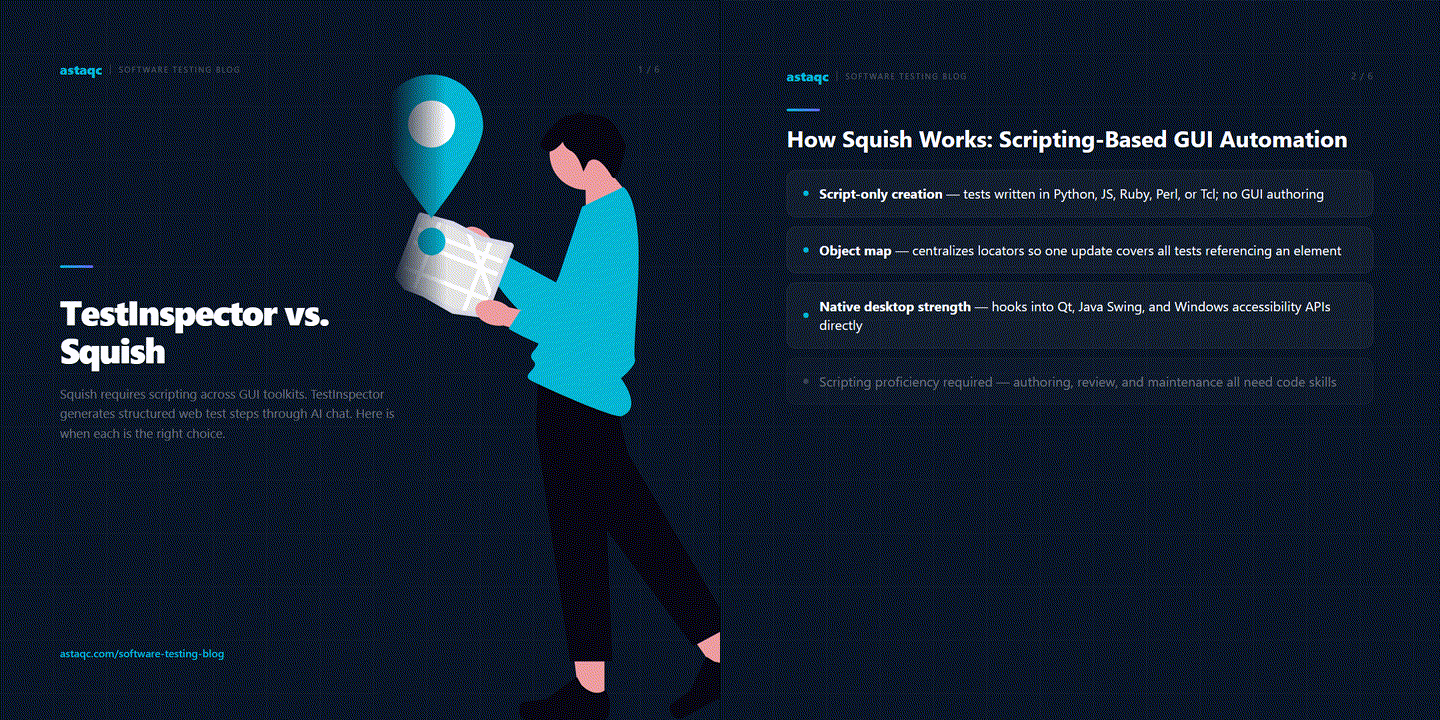
Squish is a commercial test automation tool built on a scripted automation engine. Tests are written as scripts in one of five supported languages: Python, JavaScript, Ruby, Perl, or Tcl. The test engine communicates with the application under test through hooks that vary by application type: for Qt applications, Squish hooks into the Qt event system directly; for web applications, Squish drives a browser through a built-in WebDriver implementation; for Java applications, it hooks into the Java Accessibility API; for Windows and macOS native applications, it uses the respective platform accessibility APIs.
A Squish test for a web login flow looks structurally similar to Selenium or Playwright: the test script locates elements using Squish’s object map (which stores element locators separately from test code), calls API methods to interact with those elements, and uses Squish’s verification API to assert expected states. The advantage over raw Selenium is the object map abstraction, which centralizes locator maintenance so that a changed element only requires an update in the object map rather than in each test that references it. The disadvantage is that tests remain scripts — creating them requires scripting skill, reviewing them requires reading script code, and maintaining them requires engineers familiar with both the scripting language and the Squish API.
Squish’s strongest differentiation is its native application support. Teams building Qt desktop applications, Java Swing applications, or Windows Forms applications have few alternatives that provide comparable coverage of native UI components, including custom widgets not exposed through standard accessibility APIs. For web testing specifically, Squish competes against Selenium, Playwright, and no-code tools in a market where the web automation capabilities it offers are also available from tools with lower overhead.
For teams evaluating their current GUI automation stack, Astaqc test automation services can assess whether a scripted framework like Squish fits the team’s skill profile and application type, or whether a no-code alternative better matches the workload. The manual vs. automated testing guide provides context for where GUI automation fits within a broader test strategy.
TestInspector generates test steps through an AI chat interface. A tester describes the scenario in natural language — log in with a specific username and password variable, verify the dashboard title, and assert that a navigation link is visible — and TestInspector generates the corresponding structured test steps without requiring the tester to write or review script code. Each step is represented as a discrete action with a type (click, type, assert text, navigate, HTTP request) and the parameters that action requires. The test runner executes these steps via Selenium on the configured browser.
The self-healing layer addresses one of the primary maintenance costs of GUI automation. When a selector that a test step references fails to locate an element, TestInspector’s AI suggests alternative selectors based on the element’s surrounding DOM context. The tester approves one of the suggestions, the test step updates, and the test continues running. This reduces the time required to maintain tests when the application’s markup changes without requiring manual inspection of each failing test’s locator strategy.
Variable interpolation allows tests to reference dynamic values without hardcoding them. TestInspector supports {{VAR}}, {{TIMESTAMP}}, {{ALPHANUMERIC}}, and {{TOTP:secret}} syntax, with variables scoped at the test, suite, or organization level and encrypted storage for secrets. This makes it practical to run tests across environments without maintaining environment-specific test versions, and to test authentication flows that require time-based one-time passwords without embedding TOTP secrets in test scripts.
Visual regression testing uses SSIM screenshot comparison against approved baselines. Each test run captures screenshots at configured steps, computes the structural similarity score against the baseline, and flags steps where the score falls below the threshold. Crop and exclusion selectors allow dynamic content regions — timestamps, user avatars, advertising areas — to be excluded from the comparison so that tests do not fail on expected variation. For a detailed view of what TestInspector offers, visit the TestInspector product page. Teams already working with Astaqc software testing services can get support integrating TestInspector into an existing test operation.
| Dimension | TestInspector | Squish |
|---|---|---|
| Test creation method | AI chat interface generates structured steps; no scripting required | Scripts written in Python, JavaScript, Ruby, Perl, or Tcl |
| Application coverage | Web browsers: Chrome, Firefox, Edge, Safari | Web browsers, Qt, Java (Swing/FX), Windows, macOS, embedded |
| Selector maintenance | AI self-healing: suggests alternative selectors when elements change | Object map centralizes locators; manual update required when UI changes |
| Visual regression | SSIM screenshot comparison with baseline approval, crop, and exclusion selectors | Screenshot verification available; less granular exclusion control |
| Variable management | {{VAR}}, {{TOTP:secret}}, {{TIMESTAMP}}, encrypted storage, suite/org hierarchy | Data-driven testing via CSV or database; variable substitution in scripts |
| API testing | HTTP request steps with status, body, and header assertions built into test flow | REST module available; scripting required for request construction |
| Scheduling and CI/CD | Cron/interval/one-time scheduling, CI trigger API, live WebSocket run streaming | Command-line runner for CI integration; scheduling via CI platform |
| Accessibility testing | axe-core assertions with severity levels built into test steps | Not included as a built-in test step type |
| Deployment model | Cloud SaaS; no local infrastructure required for test execution | On-premises license; test server runs locally or in team infrastructure |
| Skill requirement | Manual testers can create and maintain tests without scripting | Requires scripting proficiency in at least one supported language |
| Export formats | Playwright TypeScript, Selenium IDE (.side), Gherkin | Proprietary script format; no standard export |
The most consequential difference between the two tools is the scripting requirement. Squish tests must be written in a scripting language, which means creating tests requires engineering time and that reviewing, maintaining, and debugging tests requires the same skill. TestInspector’s structured step model makes test creation and review accessible to manual testers and QA engineers without scripting backgrounds. For teams where test authorship currently depends on developer availability, this difference is the primary factor in the tool choice. For teams evaluating whether their current automation approach creates bottlenecks, Astaqc hire QA team can assess team capacity and skill profiles against the automation tool requirements. The outsourcing QA guide covers how to structure test automation engagements that reduce dependency on internal scripting expertise.
TestInspector is the appropriate choice when the application under test is web-based, the team includes manual testers or QA engineers who should be able to create and maintain automation without developer support, and the priority is reducing maintenance overhead rather than maximizing script-level flexibility. Teams that have tried Selenium or Playwright and found that framework maintenance consumes more time than test writing typically see immediate productivity improvement with TestInspector, because the structured step model separates test logic from implementation details that cause framework maintenance overhead.
Specific scenarios where TestInspector’s architecture provides measurable advantage over Squish for web testing: authentication flows that require TOTP (TestInspector’s {{TOTP:secret}} variable handles time-based OTP generation natively without requiring a helper library in the test script); visual regression validation where teams need to approve and track intended appearance changes rather than just detect pixel differences; and CI/CD integration where teams want live test run visibility during pipeline execution (TestInspector’s WebSocket streaming shows step-level results in real time). For teams considering migrating existing Squish web tests to TestInspector, Astaqc manual testing services can support the transition by documenting existing test coverage and rebuilding critical paths in TestInspector’s structured step format. The AI in software testing guide covers how AI-native tools like TestInspector fit within a broader quality engineering strategy in 2026.
Squish is the appropriate tool when the application includes native desktop components that TestInspector cannot reach. Qt applications with custom widgets, Java Swing applications, Windows Forms applications, and cross-platform desktop GUIs require an automation tool that hooks into the native accessibility layer or the application framework directly. TestInspector operates within web browsers via Selenium; it cannot automate native file system dialogs, OS-level menus, or non-browser application windows. If any part of the critical test path involves a native UI component, Squish’s native automation capability makes it the required choice for that path.
Squish also remains appropriate for teams that require a high degree of scripting-level control over test logic: conditional branching based on runtime application state, programmatic data generation within the test, or integration with proprietary internal test libraries. Teams that have invested significantly in Squish’s object map infrastructure and built a large test corpus should weigh the migration cost against the expected reduction in maintenance overhead, particularly if the application includes native UI components where Squish is the only viable tool regardless of web testing preference. For teams assessing whether their test automation investment is delivering the expected return, Astaqc performance testing services can evaluate automation portfolio health. The software testing cost guide provides a framework for calculating automation ROI across different tool categories.
Yes, for teams using Squish exclusively for web browser automation without native desktop coverage, TestInspector covers the same application surface with significantly lower maintenance overhead. The transition involves rebuilding existing Squish web tests as TestInspector structured steps, which is typically faster than the initial Squish test authoring because TestInspector’s AI chat interface generates step structures from natural language descriptions. Teams with large Squish web test suites should prioritize rebuilding the highest-value regression paths first and evaluate the new tooling against those paths before committing to a full migration.
TestInspector’s AI self-healing layer addresses locator failures by analyzing the surrounding DOM context and suggesting alternative selectors when an element cannot be found by its original selector. For custom web components built on Shadow DOM, TestInspector’s browser extension can capture selectors from within shadow roots during recording, and the self-healing layer uses DOM context analysis to suggest stable selectors when shadow root structure changes. For applications with complex Shadow DOM usage, the practical approach is to test through the component’s exposed attributes and behavioral surface rather than attempting to locate internal shadow tree elements.
TestInspector supports data variation through its variable interpolation system. Variables can be set at test, suite, or organization scope and referenced as {{VAR}} within step parameters. For parameterized test runs across multiple data sets, the current model requires creating test variants with different variable sets or using the API to trigger runs with different parameter values. Squish’s data-driven testing model, which allows a single script to iterate over a CSV or database table of input rows, is more flexible for bulk parameterization scenarios. Teams with high-volume data-driven test requirements should evaluate whether TestInspector’s variable model covers their specific pattern before committing to migration.
Squish is licensed per seat and per application type: a Qt license does not cover Java or web automation, and separate licenses are required for each toolkit. The licensing model is on-premises. TestInspector is a cloud SaaS product; licensing is based on usage and team size rather than application type coverage. For teams testing multiple application types with Squish today, migration to TestInspector covers only the web browser portion of the coverage, and the Squish license cost for non-web application types would remain if those applications need automated testing.
TestInspector exports to Playwright TypeScript, Selenium IDE (.side), and Gherkin. Squish does not import any of these formats directly, as Squish tests are written in its proprietary scripting format. If a team wants to maintain tests in both tools during a transition, the tests need to be authored separately in each environment. The Gherkin export can serve as a human-readable specification that Squish scripts implement, but it does not automate the Squish script creation. For teams planning a phased migration from Squish to TestInspector, Astaqc testing documentation services can help produce the test coverage mapping needed to manage a parallel tooling transition without gaps.
TestInspector’s browser extension records user interactions and generates structured test steps. The recording captures element interactions, navigation, and input values, and the resulting steps are editable through the same step interface used for AI-generated tests. Squish’s record-and-playback for web tests generates script code, which must be reviewed and edited in the scripting language used. The practical difference is that TestInspector’s recorded tests are accessible to non-scripting team members for review and maintenance, while Squish’s recorded scripts are code artifacts that require scripting familiarity to modify. For teams where manual testers own the recorded test suite, TestInspector’s recording model fits the team’s skill profile more directly.
TestInspector’s AI-native no-code model reduces the scripting and maintenance burden that Squish requires for web test automation. For teams testing modern web applications, the choice between the two tools comes down to whether native desktop coverage is required — if it is, Squish is the appropriate tool; if it is not, TestInspector’s execution model is significantly simpler to operate.
August 25, 2026


Sign up to receive and connect to our newsletter

We founded ASTAQC as a tight-knit group of professional Software Testers and software developers.
Subscribe to our Newsletter