August 31, 2026
Qase is a cloud-based test case management platform that helps QA teams write, organize, and track manual and automated test cases through a structured repository. TestInspector is an AI-native no-code execution tool that generates structured test steps from natural language and runs them against a real browser without requiring any test case management infrastructure. Teams evaluating both tools are choosing between a dedicated test organization layer and an integrated AI-driven test creation and execution system.
Qase provides a centralized location for QA teams to write test cases, organize them into suites and plans, and link test runs to requirements or issues in tools like Jira, GitHub, and Linear. Its test repository makes it possible to search for existing test cases by feature, component, or tag, and to track coverage across a product area without digging through a test automation framework’s directory structure.
For teams running manual testing, Qase’s run execution interface guides testers through each step, allows them to record actual results, and generates a run report at the end. For automated tests, Qase integrates with Playwright, Cypress, Selenium, and other frameworks through its API and reporters, allowing automated results to be pushed into Qase’s test run history alongside manual results.
Qase also tracks defects linked to failed test cases and maintains a history of test run results over time, making it possible to identify which test cases fail repeatedly, which features have the most flaky coverage, and whether test pass rates are trending up or down across releases. For QA teams that need to report test coverage and quality metrics to engineering managers or product owners, this reporting layer is the core value proposition. Teams managing a large manual or mixed manual-automated test suite that need to demonstrate coverage will find Qase’s organization and reporting tools directly useful. Astaqc’s manual testing services and software testing services address the same documentation and coverage traceability needs for teams that prefer to outsource test execution.
TestInspector does not use a traditional test case repository. Instead, a tester describes a scenario in plain language through an AI chat interface, and the AI returns a structured list of discrete test steps—navigate, click, type, assert, and similar actions—that can be reviewed, edited, and immediately executed. The execution engine is Selenium-based and drives a real browser across Chrome, Firefox, Edge, and Safari without any script files, configuration layers, or framework dependencies.
Each test in TestInspector lives in a suite hierarchy that provides variable scoping at test, suite, and organization levels. This replaces the folder and suite structure in a test case management tool with a lightweight, execution-first hierarchy. Tests can be organized by feature or component within suites, and suite-level variables allow shared configuration—base URLs, credentials, and environment values—to be maintained in one place and inherited by all tests within the suite.
TestInspector covers the full range of assertions a QA team typically needs: browser state assertions after UI interactions, HTTP request steps with status code and response body assertions for API-layer validation, visual regression via SSIM screenshot comparison with a baseline approval workflow, and axe-core accessibility assertions with severity level filtering. TOTP variable types handle two-factor authentication test flows, and variable interpolation supports timestamps, alphanumeric tokens, and encrypted stored secrets. Tests can be scheduled via cron, interval, or one-time triggers, with execution progress streaming live over WebSocket. For teams integrating with CI/CD pipelines, a REST trigger API initiates test runs programmatically, and MCP tokens allow AI assistants including Claude Code and Cursor to generate and run tests without leaving the development environment. The complete feature set is described at TestInspector.
Where Qase stores test cases as documentation that may or may not have an associated automation script, TestInspector treats the test definition and the executable test as the same artifact. This eliminates the synchronization problem that occurs in many QA teams: the test case written in a management tool describes a scenario that the automation framework tests differently, and neither one is updated when the product changes.
The comparison below covers the main dimensions teams evaluate when choosing between a test management platform and an AI-native execution tool:
| Dimension | TestInspector | Qase |
|---|---|---|
| Primary function | AI-native test creation and execution | Test case management and run tracking |
| Test authoring | AI chat interface — natural language input | Manual editor — write steps as documentation |
| Execution engine | Built-in Selenium — no external framework | Integrates with Playwright, Cypress, Selenium via reporters |
| Manual test runs | Not the core model — tests execute automatically | Step-by-step guided run interface for manual testers |
| Browser support | Chrome, Firefox, Edge, Safari | Depends on connected automation framework |
| Visual regression | SSIM screenshot comparison with baselines | Not included — requires separate tool |
| Accessibility testing | axe-core assertions with severity levels | Not included |
| API testing | HTTP request steps with assertions | Via connected automation framework |
| Requirements traceability | Not built in | Links test cases to Jira/GitHub/Linear issues |
| Test coverage reporting | Run history and pass/fail logs | Detailed run reports, pass rates, defect linkage |
| CI/CD integration | REST trigger API and MCP tokens | API reporters push results from CI pipelines |
| Script-free operation | Yes — no code required at any stage | Manual testing is code-free; automation requires a framework |
| Self-healing | Auto-retry with AI selector suggestions | Not applicable — not an execution engine |
Teams that use Qase primarily to organize manual test cases and guide manual test runs typically find that the tool’s value scales with the manual testing headcount. When a team begins automating more test scenarios, the test case repository becomes a maintenance burden: the documented test case, the automation script, and the actual application behavior are three separate artifacts that can diverge. Keeping them synchronized requires discipline, and most teams eventually find that the documentation layer in the test management tool stops reflecting what the automation actually does.
TestInspector’s model eliminates this divergence by making the test definition executable. When the test steps in TestInspector describe what the test does, those steps are also what the tool executes. There is no separate script to maintain, no automation framework directory to update, and no documentation to synchronize. Teams that find themselves spending significant time updating Qase test cases to reflect application changes, or maintaining a parallel automation framework alongside a Qase repository, tend to find TestInspector’s integrated approach more sustainable at the coverage volumes needed in 2026.
Qase remains the right tool for teams with significant manual testing workflows, for QA functions that need to report coverage and defect linkage to stakeholders who expect test case management terminology, and for teams working with contractors who need structured test plans as deliverables. For teams managing this kind of compliance-oriented testing, Astaqc’s testing documentation services and QA team services provide structured coverage artifacts alongside test execution.
The practical signal for switching is whether the team’s bottleneck is test organization and reporting or test creation speed and execution coverage. If building new automated coverage faster is the constraint, TestInspector addresses it directly. If the constraint is stakeholder reporting, audit trails, and requirements traceability, Qase addresses those needs and TestInspector alone does not. Teams facing both constraints sometimes use TestInspector for execution while maintaining a lightweight Qase repository for stakeholder-facing reporting, populated from TestInspector run results via the API. For teams designing this kind of integrated quality strategy, the guide to outsourcing QA and the complete software testing guide provide useful grounding on matching tools to team structure and coverage goals.
For most scenarios yes, with the exception of requirements traceability and stakeholder-facing coverage reports in a test management format. TestInspector handles test creation, execution, scheduling, and run history, but it does not produce the Jira-linked coverage matrices or audit-trail reports that Qase generates for compliance-oriented teams. Teams that need those artifacts alongside execution will need either Qase or a similar tool alongside TestInspector.
Qase does not execute tests itself. For automated tests, it depends on integration with existing automation frameworks like Playwright, Cypress, or Selenium. The framework runs tests in the CI pipeline, and a Qase reporter pushes results into the Qase test run history. Qase’s guided run interface is for manual testers executing documented test cases step by step, not for automated browser execution.
TestInspector’s self-healing mechanism detects selector failures at runtime and provides AI-generated alternative selectors that the tester can approve or reject. This reduces the maintenance burden compared to hand-written Selenium or Playwright scripts, where a changed selector requires a developer to locate the file, update the selector, and push a fix. TestInspector surfaces the failure and the suggested fix in the run log without requiring access to a code repository.
TestInspector stores run logs, step-level results, and screenshot comparisons, which can serve as test evidence for audit purposes. For industries that require test case documentation linked to requirements before execution, a dedicated test case management tool like Qase provides a more structured traceability model. The practical question is whether the regulation requires pre-execution documentation linked to requirements or whether post-execution run logs with step-level detail are sufficient.
The most practical approach is to run TestInspector in parallel with Qase for a sprint or two, automating new test scenarios in TestInspector while maintaining existing manual and automated tests in Qase. As TestInspector’s coverage grows to include the scenarios previously run manually in Qase, the manual run cadence in Qase can be reduced. Teams migrating from a code-based automation framework that reports into Qase follow a similar parallel-run approach, using TestInspector’s export to Playwright TypeScript to validate behavioral equivalence before removing the framework tests.
TestInspector’s CI/CD trigger API and MCP tokens allow test runs to be initiated from and connected to CI/CD pipelines, where results can be linked to deployment events and pull requests. Direct Jira integration for requirements traceability is not a built-in feature in the way Qase provides it. Teams that need this linkage typically manage it through the CI/CD layer, where test results from the trigger API are posted as comments on the triggering PR or deployment event. For more on Astaqc’s approach to test automation strategy and tool selection, the AI in software testing guide covers the current landscape in detail.
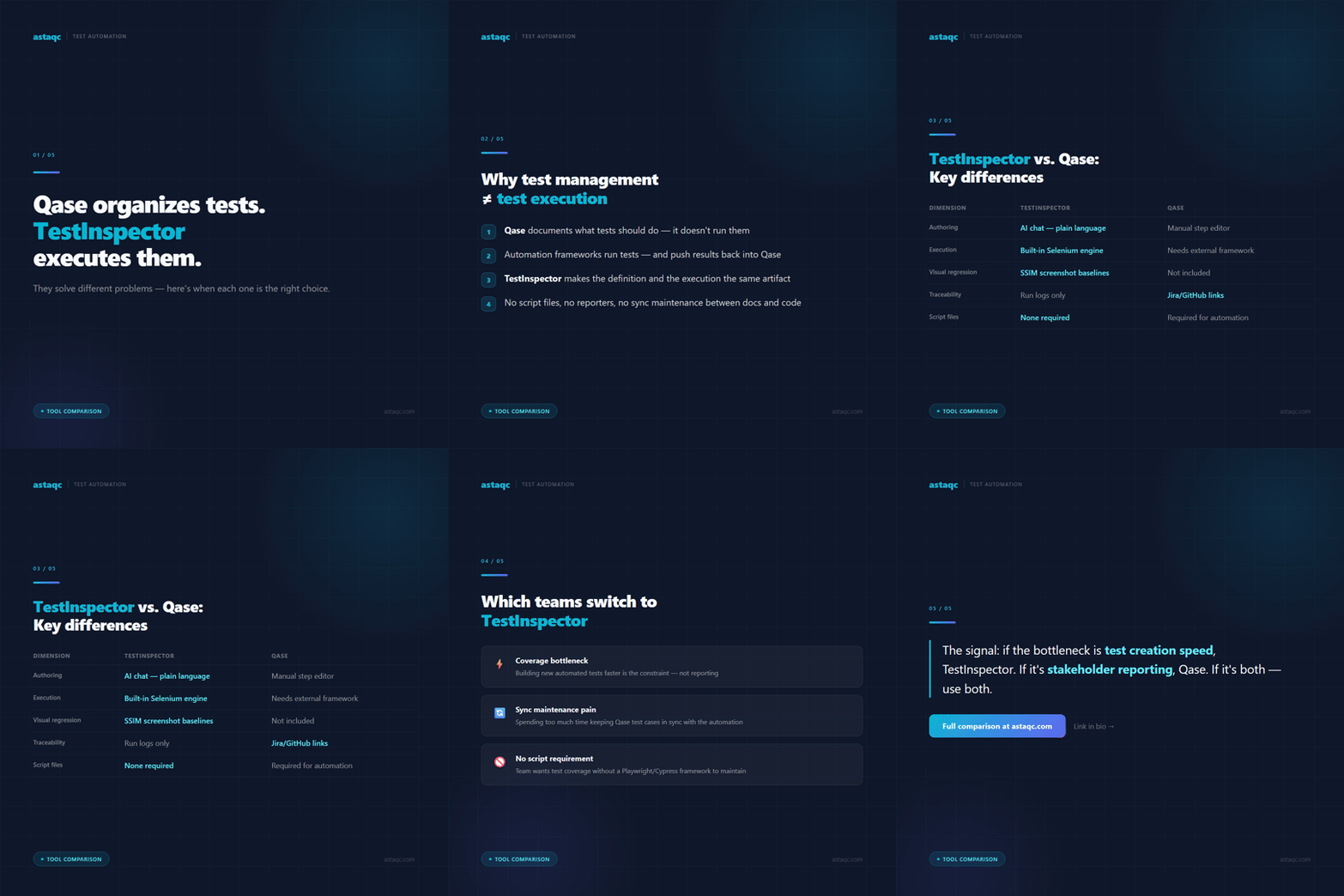
Qase manages the documentation layer around testing. TestInspector removes the documentation layer by making test creation and test execution the same action.
August 31, 2026


Sign up to receive and connect to our newsletter

We founded ASTAQC as a tight-knit group of professional Software Testers and software developers.
Subscribe to our Newsletter