September 9, 2026
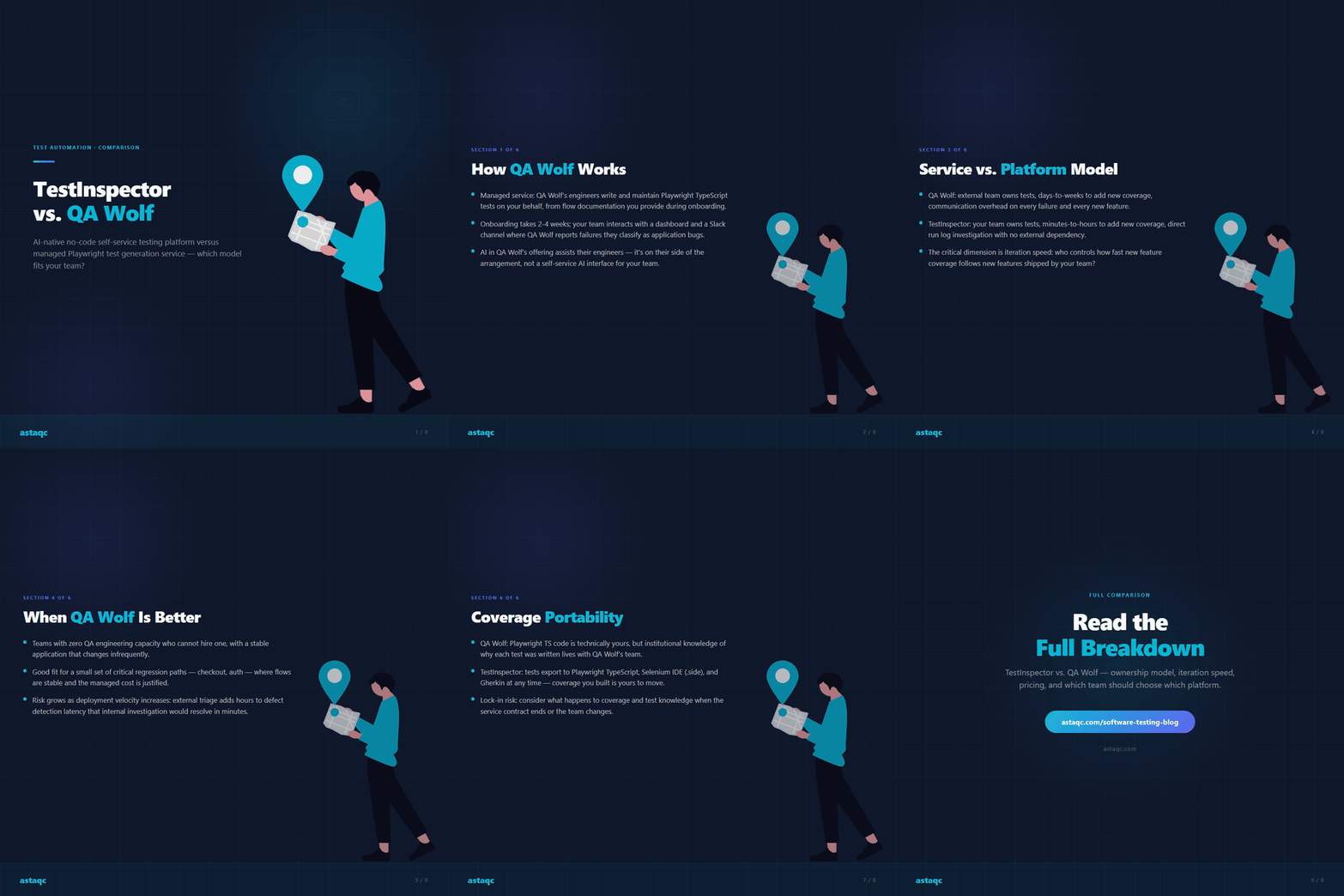
The core choice between TestInspector and QA Wolf is between a self-service platform and a managed service. TestInspector is a platform your team operates directly: an AI chat interface generates test steps as structured, human-readable steps without code, a browser extension records interactions, and tests run on TestInspector's infrastructure across Chrome, Firefox, Edge, and Safari. QA Wolf is a managed service where QA Wolf's engineering team writes and maintains Playwright TypeScript tests on your behalf, with AI tooling supporting their engineers rather than replacing them. Teams that want to own, understand, and iterate on their test coverage without maintaining a code framework choose TestInspector; teams that want to hand off the mechanical Playwright maintenance work to a service provider and receive passing test results choose QA Wolf. The decision turns on whether your team needs control and iteration speed, or whether it needs to eliminate the cost of keeping automation engineers employed on test maintenance.
Both approaches address the same underlying problem—browser test coverage without requiring your product engineers to write and maintain test code—but they solve it with fundamentally different architectures and cost structures. TestInspector charges a platform subscription; QA Wolf charges based on the scope of coverage maintained, with pricing that scales with the number of tests in scope. The operational model differs as much as the pricing: TestInspector puts your QA engineer in the driver's seat; QA Wolf puts QA Wolf's engineers in the driver's seat and creates a dependency on their team's availability and context about your application. Astaqc's TestInspector page and test automation services cover how AI-native platforms fit into a team's overall automation strategy.
QA Wolf operates as a white-glove service. After onboarding—which typically takes two to four weeks and requires your team to document the flows and user journeys you want covered—QA Wolf's engineers write Playwright tests for those flows. The tests run on QA Wolf's infrastructure on a schedule you define, typically before each deployment or on a CI merge trigger. When tests fail, QA Wolf's team investigates and either fixes a legitimate test maintenance issue (a selector changed, a flow changed) or reports the failure to your team as a genuine application defect to fix.
The AI in QA Wolf's offering is primarily on their side of the arrangement: it helps their engineers write tests faster and identify where selector drift requires updates. Your team interacts with QA Wolf through a dashboard that shows passing and failing tests, and through a Slack or email communication channel where QA Wolf reports failures they classify as application bugs. You receive coverage—in the form of passing tests and failure reports—without managing the test code yourself. The coverage quality depends on how thoroughly you documented the flows you wanted covered during onboarding and how accurately QA Wolf's engineers interpreted those requirements when writing the tests. Astaqc's guide to outsourcing software testing covers the planning work required to set up a managed testing service for reliable coverage.
TestInspector is a platform your team controls end-to-end. The primary test creation interface is an AI chat conversation: you describe what you want to test in natural language and the AI generates that test as structured steps with selectors, actions, and assertions. The browser extension provides an alternative recording path: you click through the flow in your browser and TestInspector captures the steps automatically, which you can then review and edit. Both approaches produce the same output: a structured test definition that does not require you to write or read code.
Tests run on TestInspector's infrastructure across Chrome, Firefox, Edge, and Safari. Run streaming over WebSocket lets you watch test execution in real time rather than waiting for a report. Self-healing handles selector drift: when a selector fails because the UI changed, TestInspector retries with alternative selectors and surfaces AI selector suggestions for review and approval. The variable system supports test data at test, suite, and organization scope, with TOTP support for 2FA flows and encrypted storage for credentials. HTTP request steps allow API assertions within a test run—GET, POST, PUT, PATCH, and DELETE with status code and body assertions. Accessibility assertions run against axe-core with configurable severity levels. Visual regression is handled via SSIM screenshot comparison against stored baselines, with crop and exclusion selector support. Scheduling supports cron expressions, fixed intervals, and one-time scheduled runs, with CI/CD trigger via the TestInspector API and MCP tokens for integration with Claude Code and Cursor. Astaqc's TestInspector page documents the full feature set and integration options.
The key operational difference from QA Wolf: your QA engineer writes, reviews, and iterates on tests directly. When a test fails, the engineer investigates in the TestInspector run log—which captures steps, selectors, screenshots, and timing—and decides whether to update the test or file a bug. The coverage directly reflects the judgment and knowledge of your team rather than a third-party service with limited context about your application's intended behavior. This means faster iteration on new coverage—adding a test for a feature shipped this sprint takes one AI chat conversation—but it also means your team must allocate engineering time to the test creation and maintenance work rather than offloading it.
The fundamental difference between QA Wolf and TestInspector is not a feature comparison—it is a structural difference in who operates the testing, who owns the test knowledge, and how the cost scales. The table below maps the key dimensions that determine which model fits a given team.
| Dimension | QA Wolf | TestInspector |
|---|---|---|
| Test ownership | QA Wolf engineers write and maintain the tests | Your team writes and maintains the tests |
| Test format | Playwright TypeScript code | Structured no-code steps (exportable to Playwright TS, Selenium IDE, Gherkin) |
| Coverage iteration speed | Depends on QA Wolf team availability; days to weeks for new flows | Minutes to hours; your team adds coverage independently |
| Application context | QA Wolf team has external context; requires documentation from your team | Your team has full internal context; AI assists with step generation |
| Failure investigation | QA Wolf triages; reports bugs to your team; fixes test maintenance issues | Your team investigates via run logs, step-level screenshots, streaming |
| Pricing model | Service contract; scales with test count | Platform subscription |
| CI/CD integration | QA Wolf-managed infrastructure with webhook-based triggers | TestInspector trigger API; cron, interval, and one-time scheduling; MCP tokens |
| Accessibility testing | Not a standard service offering | axe-core assertions with severity-level configuration |
| Visual regression | Not a standard service offering | SSIM screenshot comparison with baseline approval and crop/exclusion selectors |
| API testing | Via Playwright if included in a test flow | Native HTTP request steps with status and body assertions |
The most important dimension in this table is coverage iteration speed. A team shipping features weekly that wants to add test coverage for each new feature as it ships needs to add that coverage in minutes or hours, not days to weeks. QA Wolf's coverage iteration speed is bounded by their team's availability and the communication overhead of explaining a new feature to an external team without full context about your application's intended behavior. TestInspector's coverage iteration speed is bounded only by how quickly your team can describe the flow to the AI interface. Astaqc's complete guide to software testing covers coverage planning approaches for teams with varying release cadences.
QA Wolf makes the most sense for teams that have no QA engineering capacity and cannot hire one, have a stable application with infrequent feature releases, and need to demonstrate that browser automation coverage exists without building the internal competency to maintain it. The managed service model removes the requirement to hire, onboard, and retain a QA engineer with automation skills. For a startup that has three product engineers and needs some browser automation coverage before a major demo or fundraising round, QA Wolf can produce that coverage faster than building the internal capacity to write and maintain Playwright tests independently.
QA Wolf is also a reasonable choice for teams that already use Playwright internally and want a managed layer for the subset of critical paths that must never regress—checkout, authentication, core workflow completion—where the coverage is stable enough that QA Wolf's team can maintain it without frequent context updates from your team. Stable coverage on stable flows is where managed services deliver their best economics: the maintenance work is predictable, the test code does not change frequently, and the service cost is justified by eliminating the engineering time that would otherwise go into those maintenance tasks.
The risk with QA Wolf increases as the application changes more frequently and as the team needs to understand test failures quickly. An external service that triages failures and communicates them through a Slack channel adds latency to the defect detection loop. A regression that your internal engineer would have caught and classified in ten minutes by reading the run log becomes a communication exchange that spans hours when the triage is external. For teams where deployment velocity is high and defect detection latency directly affects release confidence, that communication overhead is a material operational cost. Astaqc's QA team hiring guide covers when building internal QA capacity is more effective than relying on a managed testing service.
TestInspector is the better choice when your team has at least one QA engineer who can own the test coverage, when feature releases are frequent enough that new coverage must be added quickly after each sprint, and when your team needs to understand test failures directly from run logs rather than waiting for an external triage. The self-service model gives your team full control over what is tested, how assertions are written, and how failures are investigated—which produces higher-quality coverage for applications the team understands deeply.
The no-code interface makes TestInspector accessible to QA engineers who do not have Playwright or Selenium experience. A QA engineer who previously executed manual test cases can use the AI chat interface to create and run automated tests without learning a programming language or a test framework, while retaining full ownership of the test design and assertion quality. This is a materially different proposition from QA Wolf, where the test design expertise stays with QA Wolf's team and your engineer reviews results rather than building automation skills. For teams that want to develop internal QA automation capability rather than outsource it, TestInspector builds that capability in the team over time. Astaqc's manual testing services and manual vs. automated testing guide cover how teams transition from manual testing to automated coverage with AI-assisted tools.
TestInspector also covers testing dimensions that QA Wolf does not address as standard: accessibility assertions via axe-core, visual regression via SSIM screenshot comparison, and API testing via native HTTP request steps. A team that needs to validate WCAG compliance, detect visual regressions after a design update, and assert API contracts—all in the same platform that runs its UI tests—gets broader coverage from a TestInspector subscription than from a QA Wolf contract covering browser flow testing only. Astaqc's performance testing services cover the load and stress testing dimension that neither platform addresses natively.
A practical consideration rarely discussed in platform comparisons: what happens to your coverage if you switch providers or platforms? QA Wolf's coverage lives in Playwright TypeScript code written by QA Wolf's team. If you end the service contract, you can request the test files—the code is yours—but maintaining them internally requires Playwright expertise your team may not have, and the institutional knowledge about why each test was written the way it was sits with QA Wolf's engineers rather than your team.
TestInspector tests are exportable to Playwright TypeScript, Selenium IDE (.side format), and Gherkin at any time. If your team decides to move to a code-first framework, the coverage you have built in TestInspector exports to a format your engineers can use as a starting point. The export preserves the test logic and assertion structure that your team designed—the part that required engineering judgment to create. Astaqc's AI in software testing guide and software testing cost guide cover platform selection criteria and how to evaluate lock-in risk when choosing automation tools.
Yes, and some teams do. A common pattern is using QA Wolf for a small set of critical regression paths—checkout, authentication—where the flows are stable and the managed service cost is justified, while using TestInspector for the broader suite of feature coverage that changes more frequently. The main coordination requirement is ensuring that the same flows are not covered redundantly in both platforms, which wastes budget without adding coverage value. Astaqc's test automation services include tool selection and coverage allocation planning for teams evaluating multiple platforms.
With QA Wolf, a significant feature change requires communicating the new expected behavior to QA Wolf's team, who update the tests on their side. Depending on the scope of the change and their team's availability, this can take days. With TestInspector, the team member who built the feature describes the new expected behavior in the AI chat interface and updates the test themselves, typically in the same day the feature ships. For teams with frequent feature changes, the self-service model provides meaningfully faster coverage iteration.
QA Wolf's team works from documentation your team provides: user stories, acceptance criteria, and recorded flow walkthroughs. For features with complex business logic—multi-step approval workflows, permission-gated features, application-specific data states—the documentation overhead is significant, and the tests QA Wolf writes may miss edge cases that your team's internal knowledge would catch. TestInspector avoids this overhead because the person writing the test is the same person who knows the intended behavior. For applications with complex, domain-specific logic, this knowledge gap is the main quality risk in the managed service model.
TestInspector is generally more suitable for the initial migration from manual testing to automation. The AI chat interface lets QA engineers describe tests in the same terms they would use to write a manual test case—action, expected result—without learning a programming language. QA Wolf can produce coverage faster in the short term, but it does not build internal automation capability; when the service ends, the team is in the same position as before minus the budget spent. Astaqc's TestInspector page covers how teams structure the manual-to-automated transition with AI-native platforms.
TestInspector supports multi-tenant organizations with owner, admin, and member roles that control who can create, edit, run, and delete tests. Variables defined at the organization level are accessible to all suites and tests within the organization, which supports shared credential management and environment configuration without duplicating values across tests. This role-based structure allows a QA lead to maintain organization-level settings while individual contributors work within their designated suites. The complete software testing guide covers team structure considerations for QA organizations scaling their automation coverage.
The choice between TestInspector and QA Wolf is not a feature comparison but a structural decision about who owns the testing, who holds the application context, and how quickly new coverage can follow new features.
September 9, 2026


Sign up to receive and connect to our newsletter

We founded ASTAQC as a tight-knit group of professional Software Testers and software developers.
Subscribe to our Newsletter