August 20, 2026
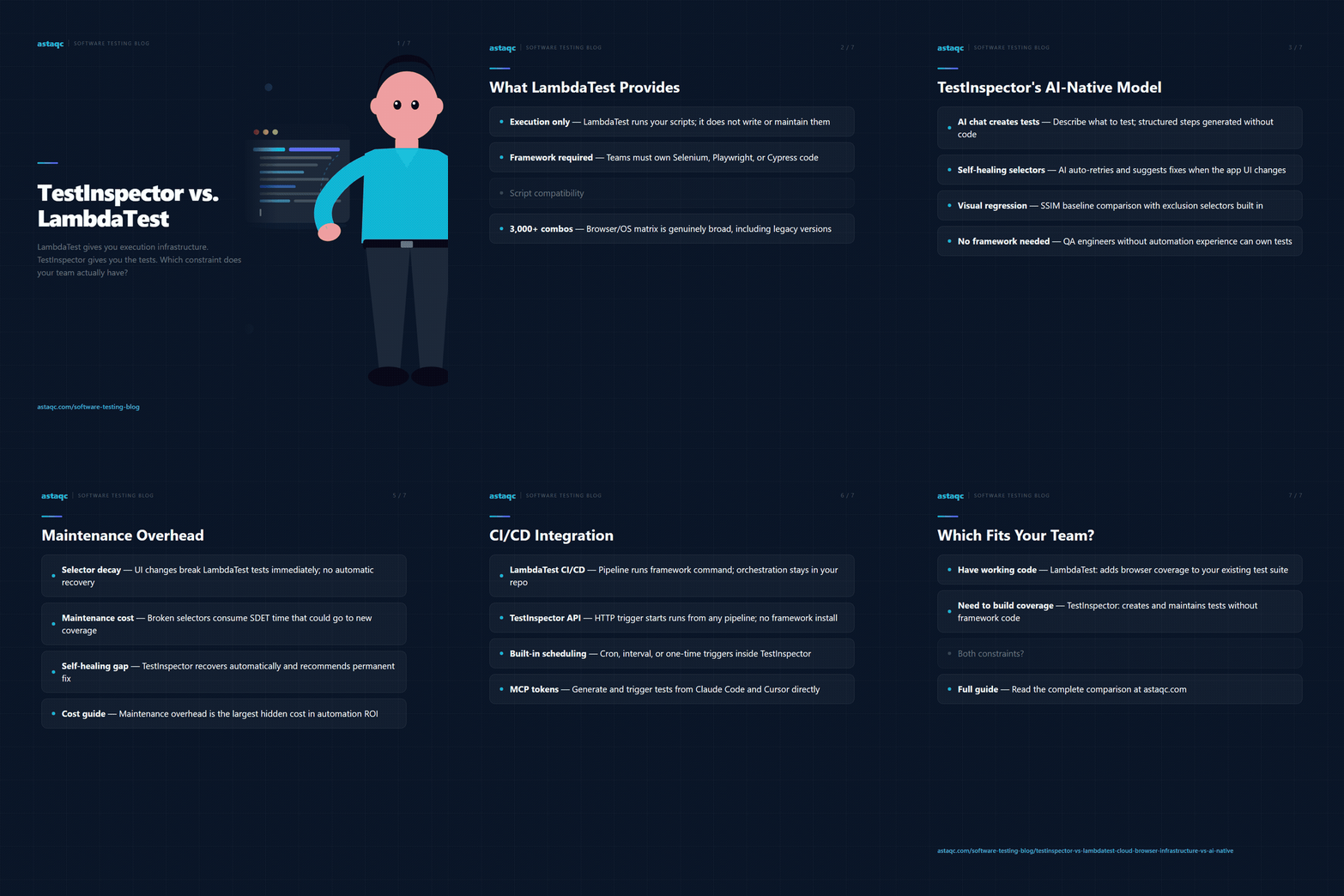
LambdaTest provides cloud browser infrastructure for running existing Selenium, Playwright, and Cypress test suites across thousands of browser and OS combinations, but it assumes the team owns and maintains the test code that executes on it. TestInspector is an AI-native, no-code test automation platform that handles test creation through an AI chat interface or browser extension recording, executes tests across Chrome, Firefox, Edge, and Safari via its own cloud infrastructure, and manages selector drift through self-healing automation — eliminating the framework ownership that LambdaTest requires. Teams choose LambdaTest when they have a functioning, code-based test suite and need cross-browser execution scale; teams choose TestInspector when they need to build and maintain coverage without writing or managing test framework code. For teams evaluating both options, the complete software testing guide covers where cross-browser testing fits in a broader QA strategy.
LambdaTest is a cloud testing platform that provides remote browser instances for executing automation scripts. Teams configure their Selenium WebDriver, Playwright, or Cypress projects to point at LambdaTest's cloud endpoint instead of a local browser, and tests run against real browsers hosted on LambdaTest's infrastructure. The platform supports over 3,000 browser, browser version, and operating system combinations, provides parallel execution slots to reduce total suite run time, and records video and screenshots of test runs for debugging failures.
The infrastructure value is real for teams that already have a functioning test automation codebase. A team running a Selenium Grid in-house eliminates that infrastructure cost by switching to LambdaTest. A team that needs to run tests on Safari without owning Mac hardware accesses Safari through LambdaTest's cloud. Parallel execution that was constrained by local machine count becomes unconstrained by hardware limits. For these teams, LambdaTest's value proposition is clear: it replaces an infrastructure problem they already have.
The model's constraint is that it addresses only the execution layer. Every other part of the automation investment — writing test scripts, maintaining selector stability when the application changes, debugging flaky tests, updating test logic when features are added or removed, and managing the test codebase as an engineering artifact — remains the team's responsibility. LambdaTest is infrastructure for an automation suite the team has already built. For teams without dedicated SDET capacity, or for teams where application change velocity exceeds the rate at which tests can be updated, the LambdaTest model requires a level of automation maturity that does not yet exist. For teams assessing the full scope of their automation investment, Astaqc's software testing services provide coverage and infrastructure assessments before committing to a tooling direction.
Cross-browser compatibility of existing test scripts is a second practical constraint. LambdaTest provides browser variety, but test scripts written primarily against Chrome often use Chrome-specific interaction patterns — shadow DOM access, event timing, element visibility behavior — that fail on Firefox or Safari without modification. Teams discover this only after running their suite against the broader browser matrix and finding failures that are application compatibility problems in the scripts, not bugs in the application. The cross-browser value materializes only after investing time to fix those compatibility issues, which can represent significant effort for a large test suite. For teams whose applications primarily serve modern browser users, the practical browser coverage gap may be narrower than LambdaTest's full device catalog suggests.
TestInspector approaches cross-browser testing from a different starting point. Rather than providing infrastructure for running scripts the team writes, it generates tests through an AI chat interface where engineers describe what to test in plain language. The AI produces structured test steps — not code — that can be reviewed and edited directly in the interface. Tests can also be created by recording interactions through the TestInspector browser extension, producing a step-by-step test capturing user actions and assertions without requiring any framework knowledge. Because the tests are structured steps rather than code, they are readable and editable by QA engineers without automation experience.
Execution runs across Chrome, Firefox, Edge, and Safari through TestInspector's own cloud browser infrastructure. The same test runs on multiple browsers from the TestInspector interface without changes to selectors, test logic, or execution configuration. Because TestInspector controls both the test structure and the execution environment, it applies self-healing logic that Selenium or Playwright running on LambdaTest cannot provide: when a selector fails because the application changed, TestInspector's self-healing mechanism tries alternative selectors and provides AI-generated selector suggestions. Tests that would fail permanently in a code-based framework due to a locator change often recover automatically, with the selector drift logged and an updated selector recommended for the next run. For teams evaluating how self-healing affects ongoing maintenance costs, Astaqc's test automation services can quantify maintenance overhead in existing framework-based suites.
Visual regression testing through SSIM screenshot comparison provides a coverage layer that LambdaTest does not offer as an integrated feature. LambdaTest captures screenshots when tests fail, but does not maintain approved visual baselines or flag visual changes that do not cause assertion failures. TestInspector maintains baseline screenshots for visual assertions, compares new screenshots using structural similarity analysis, and supports crop and exclusion selectors for dynamic regions like timestamps or user-specific content. Visual differences above the configured threshold trigger a failure requiring explicit baseline approval before the new state is accepted. The TestInspector product page covers the full specification of AI chat generation, self-healing automation, visual regression, and HTTP API test steps.
Both platforms provide cross-browser test execution, but the scope of what they cover differs. LambdaTest executes test code the team provides against a wide browser matrix; TestInspector handles both the test definition and multi-browser execution as an integrated workflow. The comparison below covers the dimensions most relevant for QA teams evaluating each platform in 2026.
| Dimension | LambdaTest | TestInspector |
|---|---|---|
| Test creation | Team writes scripts in Selenium, Playwright, or Cypress; LambdaTest provides no authoring tools | AI chat generates structured steps; browser extension records interactions; no code required |
| Browser coverage | 3,000+ browser/OS combinations, including legacy versions and physical mobile devices | Chrome, Firefox, Edge, and Safari on current versions via cloud execution |
| Selector maintenance | Manual — team updates selectors when the application changes | Self-healing with AI selector suggestions and auto-retry on selector drift |
| Visual regression | Screenshot on failure; no baseline comparison workflow | SSIM baseline comparison with crop/exclusion selectors and approval workflow |
| Test scheduling | Triggered by the CI/CD system that invokes the test framework | Built-in scheduling via cron, interval, or one-time triggers |
| CI/CD integration | Standard WebDriver endpoint; integrates with any CI tool that runs the test framework | HTTP API trigger for CI/CD; MCP tokens for AI-assisted test generation in Claude Code and Cursor |
| Run visibility | Video recordings and step-level screenshots available post-run | Live WebSocket streaming for real-time visibility during execution |
| Team model required | Engineers who can write and maintain test framework code | Accessible to QA engineers without automation framework experience |
Legacy browser version support is an area where LambdaTest maintains a meaningful advantage. Teams that must verify behavior on specific older browser versions, Internet Explorer compatibility, or physical mobile device configurations will find LambdaTest's device and browser catalog more comprehensive. For teams that need to define a browser coverage matrix matched to actual user data, Astaqc's manual testing services can structure a coverage decision based on analytics rather than covering every possible combination.
The practical cost difference between LambdaTest and TestInspector is most visible in test creation and ongoing maintenance. A team using LambdaTest starts from zero test code: they must write scripts in a framework, establish a test project structure, configure CI/CD to point at LambdaTest's endpoint, and build reporting and alerting infrastructure. The initial investment is significant, and the return depends on the team's ability to keep tests current as the application evolves.
Selector maintenance is the most common source of test suite decay in framework-based automation. When application UI changes — element IDs change, labels are updated, page structure is reorganized — test selectors that reference the old structure fail. Each failure requires a developer or SDET to identify which selector broke, update the test code, and verify the fix. For large test suites and fast-moving applications, this maintenance overhead can consume most of the QA team's available automation capacity, leaving little bandwidth for writing new tests.
TestInspector's self-healing reduces this maintenance burden by automatically trying alternative selectors when the primary selector fails. Tests do not require immediate manual intervention when a UI change breaks a selector — the self-healing mechanism recovers the test for the current run and logs the selector drift for review. For teams assessing how automation maintenance costs compare to the coverage value delivered, Astaqc's software testing cost guide covers how maintenance overhead factors into automation ROI. Teams that need to expand QA coverage without adding automation engineering headcount can explore Astaqc's hire QA team service for structured coverage support.
Both platforms integrate with CI/CD pipelines, but the integration model differs. LambdaTest integrates as an execution endpoint: the CI/CD pipeline runs the test framework command, which connects to LambdaTest's cloud and executes tests remotely. The pipeline configuration, test selection logic, parallelism settings, and result parsing are all managed by the team's CI/CD setup. This gives experienced teams full control over how and when tests run, but requires the team to build and maintain that orchestration layer.
TestInspector integrates via an HTTP API trigger that starts a test run from any CI/CD pipeline without requiring the pipeline to install or configure a test framework. Scheduling is built into TestInspector directly — tests run on cron schedules, at intervals, or on one-time triggers configured within the TestInspector interface, without depending on the CI/CD system to manage the schedule. Live WebSocket streaming provides real-time run visibility during execution, and run history is maintained for coverage trend analysis over time.
MCP tokens allow TestInspector tests to be generated and triggered from AI coding environments including Claude Code and Cursor, enabling test creation alongside code authoring rather than as a separate downstream process. Variable interpolation with {{VAR}}, {{TIMESTAMP}}, {{ALPHANUMERIC}}, and {{TOTP:secret}} support is maintained through a test-to-suite-to-org hierarchy with encrypted storage, enabling test data management without hardcoded values in test definitions. The AI in software testing guide covers how MCP-based integrations fit into AI-assisted QA workflows in 2026.
Not directly. TestInspector does not execute existing Selenium, Playwright, or Cypress scripts — it manages its own structured test format generated through AI chat or browser extension recording. A team with a large existing Selenium suite would need to migrate tests into TestInspector's format or continue using LambdaTest for the existing suite while using TestInspector for new test creation. Astaqc's test automation services can assess an existing suite's coverage contribution against its maintenance cost to inform this decision.
LambdaTest is the better choice when the team already has a functioning Selenium, Playwright, or Cypress test suite and needs to extend browser coverage or reduce infrastructure overhead without changing the test framework. It is also preferred when the team requires specific legacy browser versions or physical mobile device testing not available in TestInspector's current execution environment. Teams with dedicated SDET capacity who want full control over their test code will find LambdaTest's model more aligned with their engineering workflow.
TestInspector handles authentication as standard test steps. For time-based two-factor authentication, TestInspector supports TOTP variables that store an encrypted secret key and generate the current one-time password value at test execution time. Session handling and cookie-based authentication can be structured as precondition steps that run before the main test sequence, avoiding repeated login steps in multi-step test flows.
Yes. TestInspector supports HTTP request steps including GET, POST, PUT, PATCH, and DELETE, with status code assertions and response body assertions. API tests can be combined with browser-based UI tests in a single test sequence, making it practical to set up data via API before a UI flow, or verify database state via API after a UI action completes. Accessibility assertions via axe-core with configurable severity levels are also supported, providing WCAG coverage as part of the same test workflow.
TestInspector executes the same structured test steps across each configured browser. Visual regression through SSIM comparison catches rendering differences that functional assertions miss. For tests where cross-browser rendering variation is expected and acceptable, exclusion selectors can mask dynamic or variable regions so that known rendering differences do not produce false failures.
The deciding factor is where the team's actual bottleneck is. If the team has working automation code and needs more browser coverage at lower infrastructure cost, LambdaTest addresses that constraint directly. If the team needs to build test coverage but lacks the automation engineering capacity to write and maintain a test framework, TestInspector addresses the creation and maintenance constraint. For a structured evaluation, Astaqc's software testing services team can assess both the existing coverage gaps and the team's automation capacity before recommending a direction.
LambdaTest solves the execution infrastructure problem for teams that have already built an automation suite. TestInspector solves the test creation and maintenance problem for teams that have not. The right choice depends on where the actual constraint is: infrastructure scale, or automation capacity.
August 20, 2026


Sign up to receive and connect to our newsletter

We founded ASTAQC as a tight-knit group of professional Software Testers and software developers.
Subscribe to our Newsletter