September 8, 2026
Teams comparing TestInspector and Accelq are evaluating two AI-assisted test automation platforms that share a no-code positioning but differ significantly in execution model, deployment complexity, and the role AI plays in test creation and maintenance. Accelq is an autonomous testing platform whose AI engine analyzes the application’s structure to generate test scenarios from business flows defined at a high level; TestInspector is a no-code execution platform where tests are generated through a conversational AI interface and run as structured steps via Selenium on real browsers without any model-building phase. The practical choice between them is determined by team size, how rapidly the application is changing, and whether the team needs AI-driven test discovery across a large surface or AI-assisted creation of specific flows on demand.
The distinction between model-based autonomous generation and conversational step generation matters most during initial setup and after significant application changes. Accelq’s model-building phase requires the application to be in a stable, inspectable state before the AI can generate meaningful coverage; that phase produces broad initial coverage for established applications but creates re-analysis overhead whenever the application’s structure changes substantially. TestInspector’s conversational approach generates tests incrementally—one flow at a time as the engineer describes it—which fits applications in active development where waiting for model re-analysis is a bottleneck. Neither approach eliminates the need for engineering judgment in test design; they allocate that judgment differently. Astaqc’s test automation services include evaluation support for teams deciding between autonomous and step-based automation approaches, and the complete guide to software testing covers how AI-assisted platforms fit into broader QA strategy.
Accelq is a cloud-based autonomous testing platform built around model-based test generation. The AI engine inspects the application’s UI and API structure, builds an internal model of the application’s components and their relationships, and generates test scenarios based on business flows that the QA team defines at a conceptual level. The intent is to shift the test engineering effort from writing individual test steps to defining business process coverage and letting the AI derive the specific test paths from the application model.
The platform supports UI and API testing through a codeless authoring environment and includes parallel execution, reporting, and integrations with CI/CD pipelines and ALM tools including Jira, Azure DevOps, and ServiceNow. For test maintenance, Accelq’s AI engine is designed to re-analyze the application model when changes occur and update tests that reference components that have moved or changed. In practice, this self-healing behavior handles structural changes that are well-captured in the model; changes that alter business logic rather than UI structure require model updates that the AI cannot infer from application inspection alone.
The teams that get the most from Accelq are those with large, complex enterprise applications where building test coverage step-by-step would require more test engineering resources than the organization has. The model-based generation accelerates initial coverage creation for established applications with stable flows. For applications with frequent releases and significant UI changes between sprints, the model re-analysis cycle becomes a recurring maintenance cost rather than a one-time setup investment, which reduces the net efficiency gain compared to an incremental creation model. Astaqc’s manual vs. automated testing guide covers how to evaluate automation platforms against the specific change velocity of the application under test.
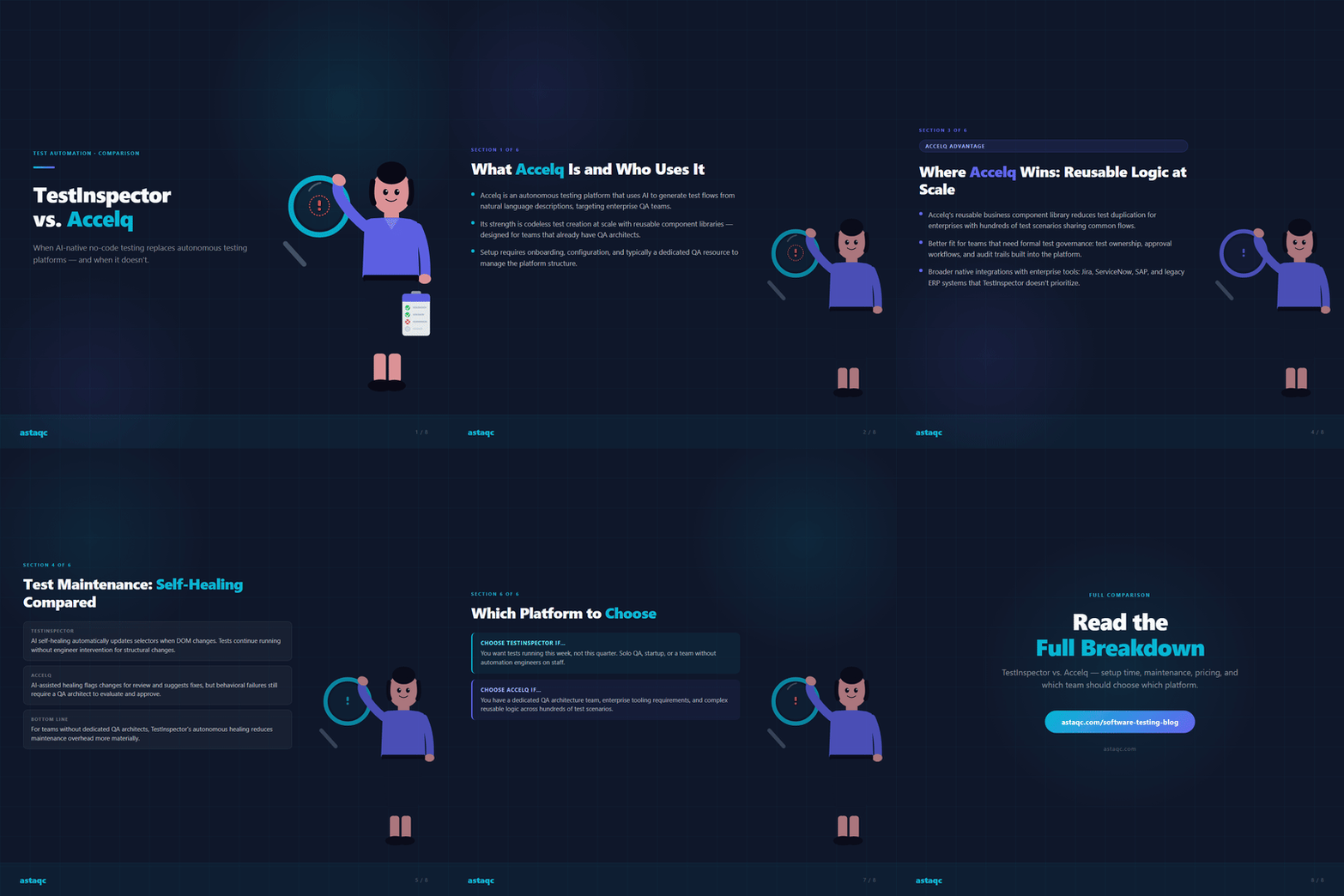
TestInspector takes a different approach to AI assistance in test creation. Rather than building an application model and deriving tests from it, the platform uses an AI chat interface where a QA engineer describes a test in natural language and the AI produces structured executable steps that can be reviewed, adjusted, and run immediately. There is no model-building phase: a new test is available to run within minutes of the engineer describing the flow, regardless of what state the application is in or how recently it was updated. This incremental creation model is lower friction for teams adding tests to active development where the application is changing between sprints.
The execution model is configured per test or suite: tests run on a defined schedule—cron expression, fixed interval, or one-time trigger—and stream results via WebSocket in real time. Historical run logs are stored for coverage tracking over time. When selectors drift because a front-end change alters class names or component structure, TestInspector auto-retries with AI-generated alternative selector suggestions, resolving most selector failures without engineer intervention. This self-healing behavior is reactive—it fires when a run fails—rather than proactive, which is the structural difference from Accelq's model re-analysis that attempts to anticipate structural changes before they cause failures.
TestInspector extends into API testing (HTTP request steps with GET, POST, PUT, PATCH, and DELETE and status code plus response body assertions), visual regression (SSIM screenshot comparison with baseline approval and crop and exclusion selectors), and accessibility assertions (axe-core with configurable severity levels) within the same step framework as browser interaction steps. Variable interpolation handles test data with TOTP code generation for 2FA flows, encrypted storage for sensitive values, timestamp and alphanumeric token generation, and test-to-suite-to-org variable hierarchy for scope-controlled configuration. The MCP token integration with Claude Code, Cursor, and Claude Desktop allows AI coding assistants to create and update TestInspector tests directly from the development environment. Multi-tenant organizations with owner, admin, and member roles allow QA leads to share coverage across teams without per-user setup overhead. Astaqc's TestInspector page covers the full feature set, and the manual testing services page covers the transition from manual execution to scheduled automated coverage for teams evaluating their first no-code platform.
The comparison below covers the dimensions that matter most for teams evaluating the two platforms. The key structural difference appears in the first three rows: how tests are created, how they are maintained, and what the upfront investment looks like before tests run consistently.
| Dimension | Accelq | TestInspector |
|---|---|---|
| Test creation model | AI builds application model; generates tests from business flow definitions | AI chat generates structured steps from natural language description; no model phase |
| Time to first test run | Model build phase required before tests can be generated and executed | Minutes from description to first run; no upfront analysis phase |
| Maintenance model | AI model re-analysis attempts proactive updates when application structure changes | Reactive self-healing: auto-retry with AI selector suggestions when a run fails |
| API testing | Supported; codeless API test authoring with assertions | HTTP request steps (GET/POST/PUT/PATCH/DELETE) with status and body assertions |
| Visual regression | Not natively included; requires separate integration | SSIM screenshot comparison with baseline approval, crop and exclusion selectors |
| Accessibility testing | Not natively included | axe-core assertions with configurable severity levels |
| 2FA and secure variables | Variable support; no native TOTP generation | TOTP generation, encrypted variable storage, test/suite/org scope hierarchy |
| Scheduling | Supported; CI/CD pipeline triggers and scheduled runs | Cron, fixed interval, one-time; WebSocket live streaming during runs |
| CI/CD integration | Native integrations with Jenkins, Azure DevOps, Bamboo, and others | CI/CD trigger API; integrates with any pipeline that can issue HTTP requests |
| ALM integrations | Jira, Azure DevOps, ServiceNow, HP ALM | Not ALM-integrated natively; CI trigger API bridges to most pipelines |
| IDE integration | Browser-based platform; no IDE plugin | MCP tokens for Claude Code, Cursor, Claude Desktop; browser extension for recording |
| Target team size | Enterprise teams with large application surfaces and ALM governance requirements | Small to mid-size QA teams needing immediate coverage without framework overhead |
The model-build tradeoff is the central evaluation criterion. Accelq's model-based generation produces broader initial coverage faster for large, stable applications; TestInspector's conversational creation produces targeted coverage faster for specific flows in rapidly changing applications. Astaqc's outsourcing guide covers how platform choice affects team structure and coverage model when QA work spans internal and contracted engineers.
Accelq provides genuine value in situations where the model-based generation approach matches the team's application structure and governance requirements.
Large enterprise applications with stable user flows are where Accelq's AI model generation delivers the promised efficiency. An application with dozens of defined business processes—order management, account provisioning, compliance workflows—can have broad initial test coverage generated from business flow definitions in a fraction of the time required to author those flows step-by-step. This efficiency gain is most pronounced in the first three to six months of implementation; after the model is built and coverage is established, the ongoing maintenance cost depends on how frequently the application's structure changes.
Teams with existing ALM governance in Jira, Azure DevOps, or ServiceNow benefit from Accelq's native integrations. When test results need to link back to work items, release artifacts, and audit records in those platforms as part of release approval processes, a platform that integrates natively reduces the configuration and credential management overhead compared to connecting an external tool through API integrations. Organizations with formal QA process documentation requirements tied to release gates benefit from those integrations more than teams that use CI/CD as their primary quality gate.
TestInspector addresses the scenarios where Accelq's model-based approach introduces overhead that outweighs its coverage generation benefit.
Teams with applications in active development—where significant UI changes ship every sprint—often find that the Accelq model re-analysis cycle creates a recurring maintenance task rather than eliminating one. Each substantial change to the application's component structure requires the model to be updated before the AI-generated tests accurately reflect the current application state. TestInspector's reactive self-healing handles the same selector drift at the individual test level without requiring a model rebuild; coverage continues running while the self-healing resolver updates the specific selectors that have changed. Astaqc's test automation services include assessment of which approach fits the team's application change velocity before recommending a platform.
Small QA teams that need browser, API, visual regression, and accessibility coverage from a single subscription benefit from TestInspector's consolidated model. Adding visual regression or accessibility testing to an Accelq implementation typically requires additional tools or integrations; TestInspector includes those in the same step framework. For teams of one to four QA engineers maintaining a testing stack without dedicated automation engineering support, the narrower tool surface is a meaningful operational advantage. The AI in software testing guide covers how tool selection affects QA team capacity at different headcount levels, and the QA team hiring guide covers how platform choice influences the skills required when growing the team. Astaqc's software testing cost guide covers how to compare per-team cost models for unified versus multi-tool automation stacks.
For a large application with established, documented business flows, Accelq's model generation can produce a broader initial coverage map faster than step-by-step conversational creation, because the AI derives test paths from the model rather than requiring the engineer to describe each flow explicitly. For smaller applications or applications where the most critical flows are concentrated in a few user paths, TestInspector's conversational approach produces usable test coverage in the same session as the description, with no model setup phase. The efficiency comparison depends on how much of the application surface needs initial coverage versus how much coverage is concentrated in specific high-priority flows.
They address similar problems through different mechanisms. TestInspector's self-healing fires when a test run fails due to a selector no longer matching the current DOM; the AI suggests alternative selectors and retries the step. Accelq's model re-analysis updates the application model proactively when structural changes are detected, attempting to prevent failures before they occur. The practical difference is that Accelq's approach requires the model update to complete successfully before tests reflect the new application state, while TestInspector's tests continue running and self-heal reactively. Neither approach handles logic changes that require test assertion values to be updated—both require engineer review when the expected application behavior changes rather than just the selector or structure.
TestInspector's CI/CD trigger API accepts HTTP requests, which means any pipeline that can issue an HTTP call—Jenkins, GitHub Actions, Azure Pipelines, CircleCI, GitLab CI—can trigger a TestInspector test run and wait for results. This covers the same pipelines that Accelq integrates with, though without the native result linking to work items in Jira or Azure DevOps that Accelq's native integrations provide. Teams that need test results linked to Jira tickets or Azure Boards work items natively will need to build that integration layer on top of TestInspector's API; for teams that track quality through CI/CD pipeline pass rates rather than ALM work item links, the trigger API is sufficient. The test automation services page covers CI/CD integration planning for teams migrating to TestInspector.
Accelq's model is most reliable for applications that have stable component structures at the level the model inspects. Frequent front-end releases that change component names, rearrange page hierarchy, or replace UI frameworks substantially require model updates that the re-analysis engine must complete accurately before tests reflect the new structure. In practice, teams with weekly releases that include significant UI changes often report more maintenance work than expected during the initial Accelq implementation, concentrated in the model update and test validation cycle after each release. This is not a limitation specific to Accelq—all selector-based automation requires maintenance after structural changes—but the model-based approach centralizes that maintenance in the model update rather than distributing it across individual test steps as TestInspector's self-healing does.
TestInspector handles multi-step flows through test suites that sequence individual tests with shared variable context. Variable values set in one test step are accessible in subsequent steps within the same suite run, allowing flows like account creation followed by order placement followed by confirmation email verification to chain correctly without resetting application state between steps. The variable scope hierarchy—test-level, suite-level, and org-level variables—controls which values are shared and which are isolated per run. For flows requiring 2FA, the TOTP variable generates the correct one-time password at execution time without hardcoding credentials. Astaqc's performance testing services cover validation of multi-step business flows under concurrent load conditions that no-code tools typically do not address.
TestInspector's self-service model allows teams to start creating and running tests immediately without a sales cycle or proof-of-concept phase. Accelq's enterprise model typically involves a demo and proof-of-concept engagement where the vendor demonstrates the model generation against the team's application, which provides a more representative preview of production coverage but requires more time before the team has usable tests running. Teams that need to show automated test results within days rather than weeks benefit from TestInspector's immediate start. The manual vs. automated testing guide covers evaluation criteria that apply across both self-service and enterprise platform selection processes.
Accelq builds an application model and generates tests from it; TestInspector generates tests from a description and runs them immediately. The difference matters most when the application is changing quickly and model re-analysis becomes recurring overhead rather than a one-time setup cost.
September 8, 2026


Sign up to receive and connect to our newsletter

We founded ASTAQC as a tight-knit group of professional Software Testers and software developers.
Subscribe to our Newsletter