August 20, 2026
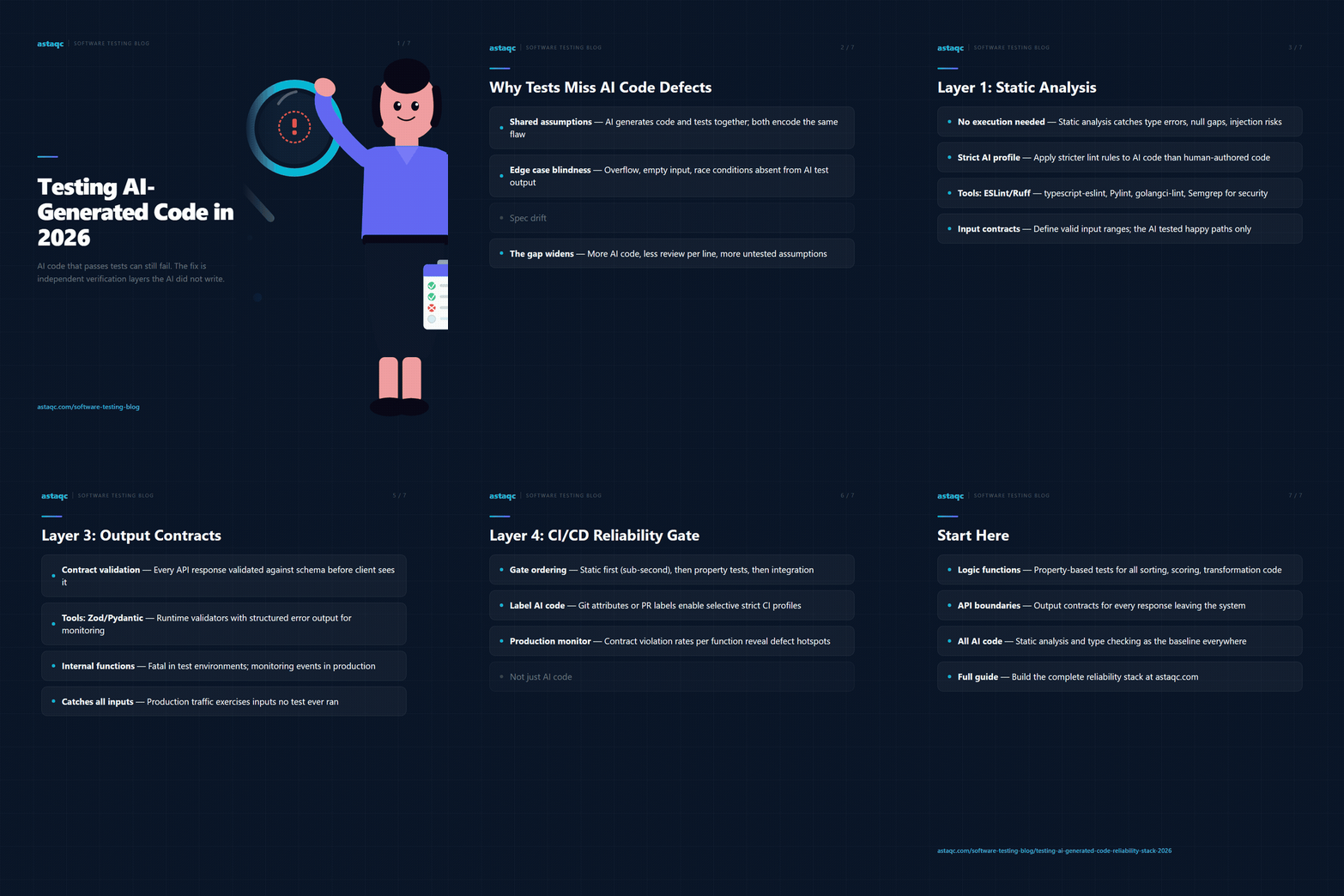
AI-generated code that passes a test suite can still fail in production because the tests were written by the same AI that generated the code, encoding the same assumptions that produced the defect. The reliability gap between a green test suite and software that works correctly under real conditions has always existed; AI-assisted development widens it because AI code generators optimize for plausible correctness — they produce code that looks right and passes tests written to match the implementation rather than the specification. Building a reliability stack for AI-generated code requires layers of verification that are structurally independent of the AI's assumptions: static analysis that checks for common defect patterns without executing the code, property-based tests that verify invariants the AI did not author, runtime output contracts that validate behavior against the original specification, and CI/CD gates that treat AI-generated code with the same skepticism applied to unreviewed external contributions. For teams assessing how AI adoption affects their overall testing strategy, the AI in software testing guide covers how AI-generated code changes the test coverage requirements for teams across different maturity levels.
When a developer writes a function and its unit tests together, the tests reflect the developer's understanding of the function's behavior. If the developer has a wrong assumption about a boundary condition, that wrong assumption is typically reflected in both the implementation and the test — the test passes, but the behavior is still incorrect. AI code generators amplify this pattern because they produce code that is internally consistent with the tests they generate. When an AI generates a function and its test suite in the same response, it produces a pair of artifacts that agree with each other whether or not they agree with the actual requirement.
The failure pattern shows up most reliably in edge cases that the AI did not include in its generated tests: integer overflow at boundary values, empty input handling, concurrent modification under race conditions, behavior under resource constraint or network failure, and security-relevant input validation at encoding boundaries. These are the cases that careful human reviewers add to test suites explicitly; they are the cases AI generators omit because they are not mentioned in the prompt and are treated as acceptable default assumptions. The dev.to article "Shipping Assumptions: A Reliability Stack for AI-Generated Code" characterizes this gap as the distance between the assumptions the code encodes and the assumptions the test suite validates — a distance that grows as AI generates more code with less human review per line of output.
A secondary failure mode is specification drift: the AI generates code that correctly implements what the prompt described, but the prompt was an incomplete representation of the actual requirement. The tests validate the implementation's behavior, not the original business requirement. By the time the code reaches production and fails, the failure is attributed to an incomplete requirement rather than a coverage gap — but the test gap is the mechanism by which the incomplete requirement was not caught during development. For teams that need QA structures to systematically catch specification drift before production, Astaqc's software testing services team can introduce requirement-traceability coverage reviews as part of the QA process. The complete software testing guide covers where specification validation fits in a layered test strategy.
Static analysis is the fastest and cheapest verification layer for AI-generated code because it runs without executing the code and catches a class of defects that tests cannot: type inconsistencies, missing null checks, unused error returns, SQL injection patterns, command injection risks, hardcoded credentials, and structural code quality problems. AI code generators produce statically-analyzable output, and the defect patterns they introduce most often — unchecked error returns in Go, missing type assertions in Python, overly permissive type annotations, and missing input sanitization — are exactly the patterns that static analysis tools catch reliably.
The practical approach is to apply a strict static analysis configuration to AI-generated code rather than the team's standard configuration. Many teams run linters with a reduced rule set in CI to keep build times short and avoid noise on legacy code. AI-generated code warrants a stricter profile because it was not written by a human who would notice and address flagged issues during authoring. Tools that apply well in this context include ESLint with typescript-eslint for TypeScript projects, Ruff or Pylint for Python, golangci-lint with errcheck and staticcheck for Go, and Semgrep rules for cross-language security pattern detection. The key is applying these tools to AI-generated code at the point of code review, where a failing check prevents the code from being merged without human intervention.
Input and output contract verification goes beyond static analysis by defining the shape and constraints of data flowing through the AI-generated function. A function that accepts a user ID should document and enforce whether it accepts integers only, whether negative values are valid, whether zero is a valid identifier, and what it returns when passed an out-of-range value. These contracts can be defined using type systems, runtime assertion libraries, or dedicated contract testing tools. The distinction matters for AI-generated code: the AI produces a function that works for the inputs it was tested with, but contracts make the function's behavior explicit and verifiable for inputs the AI did not test. For teams assessing coverage gaps in AI-assisted codebases, Astaqc's test automation services can structure a static analysis and contract verification layer as part of the CI/CD pipeline.
Property-based testing is the most effective technique for finding defects in AI-generated code because it tests the function against a large space of automatically-generated inputs rather than specific examples. Where a conventional unit test checks that a function returns the expected output for a specific input the developer chose, a property-based test defines an invariant — a rule that must hold for all valid inputs — and the testing framework generates hundreds or thousands of inputs to look for a violation. AI-generated code is particularly vulnerable to property violations because the AI's training provides many examples of common inputs but few examples at edge cases, boundaries, and rare distribution tails.
The invariants worth testing for AI-generated code depend on the function's domain, but common property categories include: round-trip properties (serializing and deserializing an object produces the original object), idempotency (calling the function twice with the same input produces the same result as calling it once), boundary preservation (the output stays within defined bounds for any valid input), and error contracts (the function returns a defined error type rather than throwing or panicking for any invalid input). None of these properties need to be specified by the AI — they are invariants a human engineer defines based on the function's specification, and the property testing framework explores inputs to find violations. Tools available in 2026 include Hypothesis for Python, fast-check for TypeScript and JavaScript, gopter and rapid for Go, and jqwik for Java.
| Property Category | What It Tests | Common Defect Caught |
|---|---|---|
| Round-trip consistency | encode(decode(x)) == x for all valid x | Data loss or corruption in serialization, Unicode handling failures |
| Boundary preservation | Output stays within defined range for all valid inputs, including extremes | Integer overflow, off-by-one errors, unhandled empty collections |
| Idempotency | Applying the operation twice gives the same result as applying it once | Side effects, state mutation, non-determinism in supposedly pure functions |
| Error contract completeness | Any invalid input returns a defined error type, never throws or panics | Missing input validation, unhandled panic paths, swallowed errors |
| Monotonicity | If input A > input B, output A >= output B (or the appropriate ordering relationship) | Incorrect comparison logic, reversed sorting, score normalization errors |
| Commutativity | f(a, b) == f(b, a) for operations where order should not matter | Asymmetric merge logic, order-dependent set operations |
The practical workflow is to run property-based tests as part of the pull request CI check for any AI-generated function that contains logic — sorting, filtering, scoring, transformation, validation, or state transitions. Pure data fetching and routing functions are lower priority; functions that implement business rules, data transformations, or validation logic are the highest priority candidates. The Hypothesis and fast-check frameworks both support shrinking: when a violation is found, the framework reduces the failing input to the minimal case that still triggers the failure, making the defect easy to diagnose and reproduce. For teams building test infrastructure for AI-assisted codebases, Astaqc's performance testing services covers how property testing integrates with performance validation under load.
Runtime output contracts validate the actual output of AI-generated functions against the specification the AI was given, independently of the tests the AI produced. A contract defines what the function must return — the schema of the output, the range of valid values, the consistency relationships between output fields — and validates that every production call satisfies the contract. This is distinct from unit testing: unit tests check specific inputs, contracts check all inputs including those that never appeared in any test.
For API endpoints, output contracts are defined using JSON Schema validators applied to every response before serialization to the client. A contract violation — a missing required field, a value outside the defined range, an incorrect type — causes the response to be rejected and logged before the client receives it. This converts runtime defects from production incidents into observable contract failures that appear in monitoring before users encounter them. Tools like Zod (TypeScript), Pydantic (Python), and go-playground/validator (Go) provide runtime validation with structured error output that can be forwarded to monitoring dashboards.
For internal functions not exposed as APIs, output contracts can be implemented as assertion blocks that run as fatal errors in non-production environments and as monitoring events in production rather than panics. This pattern is particularly useful for AI-generated logic where the full input space cannot be covered by tests and production traffic is the only way to exercise the full input distribution. For teams building structured output validation into their test infrastructure, Astaqc's testing documentation services can formalize output contracts as documented specifications, creating a traceable record of what each AI-generated function is contractually required to produce.
A CI/CD reliability gate for AI-generated code applies the verification layers described above as blocking checks before code is merged or deployed. The gate structure treats AI-generated code the same way a security-conscious team treats third-party dependencies: assume the code is not fully verified, apply independent checks, and require evidence of correctness before promotion. The checks run in order from cheapest to most expensive: static analysis first (sub-second feedback), unit and property tests second (seconds to minutes), integration tests third (minutes), and performance baseline checks last.
Labeling AI-generated code in the version control system makes it possible to apply these checks selectively. Some teams use git attributes, PR labels, or commit message conventions to mark AI-generated code; others run all code through the same gate. The selective approach reduces CI time for human-authored code that has different defect probability distributions, but it requires a reliable labeling discipline that can be enforced via pre-commit hooks. For teams adopting AI-assisted development at scale, the unified gate is more practical: apply strict static analysis, property-based test, and contract validation requirements to all code. For teams building out this infrastructure, Astaqc's manual vs. automated testing guide covers how manual review fits alongside automated gates for AI-generated code review specifically.
Monitoring AI-generated code in production provides the feedback loop that closes the reliability stack. Structured logging of contract violations, property failures found by background fuzz runs, and error rates correlated to AI-generated functions gives the team visibility into which functions carry the highest production defect rate. This data informs which functions need additional property coverage, which contracts need tighter bounds, and which AI prompting patterns consistently produce more reliable output. For teams assessing the full cost of AI-assisted development from a QA perspective, Astaqc's hire QA team service can provide QA engineers experienced with AI code verification workflows to accelerate the reliability infrastructure build-out.
No. Static analysis and type checking should apply to all AI-generated code because they are fast and catch a consistent class of defects at near-zero execution cost. Property-based testing should apply to functions that implement logic — transformation, validation, scoring, state transitions — because that is where AI generators most often encode wrong assumptions. Runtime contracts are most valuable for API boundaries and any function whose output feeds downstream business logic. Integration tests are warranted wherever the AI-generated function interacts with a database, external API, or shared state. Applying all layers everywhere is unnecessary; applying zero layers anywhere is the failure mode that produces production incidents.
The difference is in which tests the team authors versus which tests the AI authors. For human-authored code, the team writes the unit tests and is responsible for their coverage. For AI-generated code, the AI writes the unit tests and the team must provide independent verification — property-based tests that explore the input space beyond what the AI tested, and contracts that define behavior the AI may have assumed. The reliability stack described here adds the independent verification layers; it does not replace the AI-generated unit tests, which still provide useful regression coverage for the specific inputs they test.
Yes, and doing so is useful. An AI can generate property-based tests when explicitly prompted to define invariants for a function. The caveat is that the AI's property tests will reflect its assumptions, which may exclude edge cases it did not consider. The most reliable approach is to have the AI generate an initial set of property tests as a starting point, then have a human engineer review the invariants and add properties that cover edge cases the AI omitted — particularly around error handling, boundary values, and concurrent access patterns that AI generators are most likely to have assumed away.
Output contracts must be reviewed and updated whenever the AI generates a new version of a function that changes its output structure. This is a forcing function for making schema changes explicit: if the new AI-generated function produces a different output shape, the contract validation will fail immediately in CI and require a deliberate contract update that documents the breaking change. This prevents AI-generated schema changes from propagating silently to downstream consumers. For teams managing evolving AI-generated APIs, Astaqc's test automation services can structure contract versioning as part of the API change management process.
The highest-signal monitors are contract violation rates per function (a spike indicates the function is receiving inputs outside the range it was tested on), error rate correlation with deployment of AI-generated changes (a baseline comparison immediately after deployment catches defects the test suite did not), and latency regressions in AI-generated functions that include database queries or external API calls. AI generators frequently produce query patterns that are correct but not performant under production data volumes. For teams building observability infrastructure around AI-assisted development, Astaqc's software testing services team can help define the monitoring baseline and alert thresholds appropriate to each function's risk profile.
Partially. Static analysis and contract verification apply to the code that implements an AI agent's tools and infrastructure in the same way they apply to any AI-generated code. Property-based testing for deterministic functions within the agent applies normally. What does not apply is the assumption that the agent's behavior is deterministic: AI agent outputs are non-deterministic by design, so output contracts must be expressed as behavioral invariants rather than exact output specifications. Testing AI agent behavior requires scenario-based testing, output classification rather than assertion, and statistical coverage over large sample sizes. The manual vs. automated testing guide covers where human evaluation remains necessary for validating AI agent behavior in 2026.
AI code generators optimize for plausible correctness, not verified correctness. The reliability gap between a passing test suite and working software has always existed, but AI-assisted development widens it because the code and its tests can share the same wrong assumptions. Independent verification layers are the structural fix.
August 20, 2026


Sign up to receive and connect to our newsletter

We founded ASTAQC as a tight-knit group of professional Software Testers and software developers.
Subscribe to our Newsletter