September 2, 2026
Testing real-time features in 2026 requires strategies tailored to each delivery mechanism: polling systems can be tested with timed HTTP assertions verified against expected update intervals, WebHook delivery requires capturing outbound HTTP calls to validate payload structure and retry behavior, and Server-Sent Events need a persistent connection test client that validates event stream format, reconnection handling, and event ordering. Most test automation frameworks handle HTTP request-response testing well but lack native support for long-lived connections and asynchronous event delivery, which means real-time features require custom test infrastructure or purpose-built tooling that goes beyond standard assertion libraries.
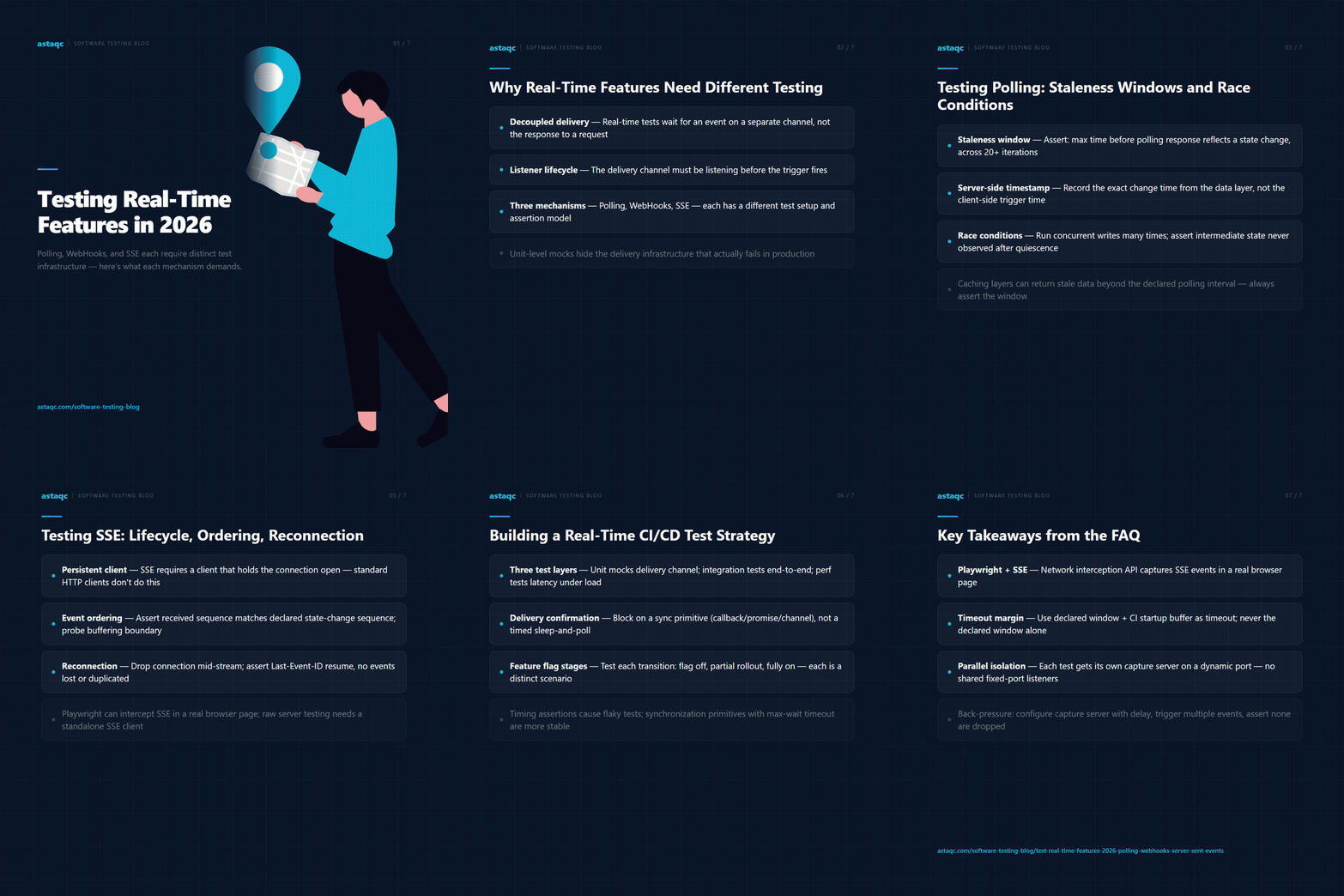
The underlying challenge is that real-time features break the request-response model that most test frameworks assume. A conventional integration test sends a request and asserts on the response. A real-time feature test sends a trigger—a data update, a state change, a user action—and then waits for a delivery event on a separate channel. The trigger and the delivery are decoupled, the delivery timing is non-deterministic within a bounded window, and the delivery channel (a WebHook endpoint, an SSE stream, a polling response) must be active and listening before the trigger fires. Designing tests for this pattern requires explicit control over timing, listener lifecycle, and delivery confirmation that standard test runners do not provide out of the box.
Teams building real-time feature tests often discover these gaps during integration testing rather than at the unit level, because the unit-level mock of the real-time channel obscures the delivery infrastructure that actually fails in production. Astaqc’s test automation services include real-time feature test design as a distinct service area, and the complete guide to software testing covers how different test layers address real-time feature reliability.
Real-time features deliver state changes to clients without requiring the client to explicitly request them. The three primary mechanisms—polling, WebHooks, and Server-Sent Events—each have a different relationship between the server’s delivery event and the client’s test assertion, and each requires a different test setup to verify that delivery happened correctly.
Polling is the simplest mechanism to test because it is fundamentally request-response: the client requests the current state at an interval, and the server responds. The real-time behavior emerges from the polling frequency rather than from any push mechanism. The test challenge is not the request itself but the staleness window: how long after a state change does the polling response continue to return stale data? Tests for polling features need to assert on the staleness window, which requires knowing when the state change occurred and how many polling intervals elapsed before the response reflected the change.
WebHooks invert the delivery model: the server initiates an HTTP request to a client endpoint when an event occurs. Testing WebHook delivery means running a server that can receive these outbound HTTP calls during the test and asserting on the payload, headers, timing, and retry behavior. The test infrastructure needs to be publicly reachable or placed within the same network as the system under test, which adds setup complexity that is absent from standard endpoint testing. In CI environments, this typically means running a local WebHook capture server as a test fixture or using a tunneling service to expose a local port.
Server-Sent Events open a persistent HTTP connection from client to server, and the server delivers events as text/event-stream data over that connection. Testing SSE requires a test client that opens and maintains the connection, receives and parses events in order, handles reconnection when the connection drops, and verifies that the event stream terminates cleanly when the server closes it. Standard HTTP clients that assume short-lived connections are not suitable SSE test clients without modification. Astaqc’s software testing services cover infrastructure design for real-time test fixtures, and the AI in software testing guide addresses how AI tools handle real-time feature coverage.
The core assertion for a polling-based feature is the staleness window: after a state change, what is the maximum time before the polling response reflects the new state? This assertion requires three timing measurements: when the state change was written to the source of truth, when the first polling response that reflects the change is received, and how many polling intervals elapsed between those two events. A well-designed polling test fixtures these measurements explicitly rather than inferring them from test execution timestamps, which can vary based on test runner overhead and network latency.
Staleness window tests work as follows: trigger a state change via direct API call to the data layer, record the exact server-side timestamp of the change (not the client-side time of the trigger), then begin polling at the expected interval and record the timestamp of the first response that includes the changed value. The difference between these two timestamps is the observed staleness window. The assertion is that this window is less than the declared maximum, typically one polling interval plus an acceptable margin for propagation delay. Running this test across 20 or more iterations provides a distribution of staleness windows that reveals whether the implementation consistently meets its lateness budget or whether outlier cases exceed the declared window.
Race conditions in polling systems occur when concurrent state changes interleave in ways that cause a polling response to reflect an intermediate state rather than the final state. Testing for this requires two concurrent writes to the same resource with a defined ordering, followed by polling assertions that confirm the final state—not the intermediate state—is reflected within the expected window. Most race condition tests for polling systems are deterministic only in their setup: the writes can be ordered, but whether the polling client observes the intermediate state depends on timing that varies across runs. Statistical approaches—running the concurrent write scenario many times and asserting that the intermediate state is never observed in the polling responses after a defined quiescence period—are more reliable than single-run assertions for this class of test.
WebHook testing requires a listener that captures inbound HTTP calls during the test and exposes their content for assertion. The simplest implementation is a local HTTP server started as part of the test fixture, which records incoming requests and exposes them through an in-process API that the test can query after triggering the event that should cause the WebHook delivery. In CI environments where the system under test runs in an isolated container network, the local server must be reachable from within that network, which typically means adding it as a sidecar service in the test compose configuration.
The payload assertions for WebHook delivery should cover the following, in order of importance: HTTP status code returned to the sender (the system under test waits for a 200-range response to consider delivery confirmed), payload structure (JSON schema validation against the declared WebHook event schema), required fields (all declared event fields are present and non-null where required), field types and formats (timestamps in ISO 8601, UUIDs in the correct format, numeric fields within declared ranges), and signature verification (if the system uses HMAC signatures for payload authentication, the signature header must validate correctly against the shared secret). Teams that skip signature verification in tests create a gap where the production verification logic is never exercised in CI, which is the most common source of WebHook authentication failures in production.
Retry behavior is the most neglected aspect of WebHook testing. When the capture server returns a non-200 response (simulating a transient delivery failure), the system under test should retry delivery at the declared interval. The test fixture can simulate this by returning 500 for the first N delivery attempts and 200 on the N+1th attempt, then asserting that the payload received on the final delivery matches the original event payload. This confirms that retry logic is implemented, that retries do not duplicate or modify the payload, and that the retry count and interval match the declared retry policy. For teams building internal WebHook infrastructure, Astaqc’s performance testing services can help validate WebHook delivery throughput and retry behavior under load conditions that reveal queuing and rate-limiting behaviors invisible in low-volume tests.
SSE tests require a client that is not a standard HTTP client. The connection must remain open after the server sends the 200 response with Content-Type: text/event-stream, events must be parsed from the newline-delimited text/event-stream format as they arrive, and the client must implement the SSE reconnection protocol (using the Last-Event-ID header on reconnect if the server sends event IDs). Most HTTP testing libraries provide no native support for this connection model; teams building SSE tests either use a browser-side EventSource implementation in a headless browser context or implement a minimal SSE client in the test runner’s language (Node.js, Python, or Go all have SSE client libraries suitable for test use).
Event ordering tests verify that events arrive in the correct sequence when the server produces multiple events in rapid succession. The assertion is that the sequence of event data values received by the test client matches the declared sequence of state changes. This test is sensitive to buffering behavior: some SSE server implementations buffer events and flush them in batches, which can deliver events out of order if the batching window interleaves with concurrent event production. The test should produce events at a rate fast enough to exercise the buffering boundary while verifying that the client-side sequence is correct.
Reconnection tests simulate connection drops by closing the connection from the server side mid-stream and verifying that the client reconnects and resumes event delivery from the correct point. When the server assigns event IDs, the reconnecting client sends the Last-Event-ID header with the ID of the last received event, and the server should resume delivery from the subsequent event. The test asserts that no events are lost during the reconnection window and that no events are delivered twice. This test covers behavior that is extremely difficult to observe in manual testing—the reconnection happens in milliseconds—but represents a real production failure mode when mobile clients reconnect after network transitions.
The comparison below summarizes the test infrastructure requirements and primary assertion targets for each real-time delivery mechanism:
| Mechanism | Test infrastructure needed | Primary assertions | Common failure modes |
|---|---|---|---|
| Polling | Standard HTTP client; test clock control | Staleness window, eventual consistency, race condition handling | Caching returning stale data; race conditions on concurrent writes |
| WebHooks | Local capture server; network routing from SUT to test | Payload structure, HMAC signature, retry count and interval | Signature verification skipped; retry duplication; payload mutation on retry |
| SSE | Persistent SSE client; connection lifecycle control | Event ordering, reconnection with Last-Event-ID, clean connection close | Event loss during reconnect; out-of-order delivery from batching |
| WebSockets | Persistent WS client; bidirectional message capture | Message ordering, heartbeat handling, reconnection after close | Message loss on network transition; unhandled close codes |
The infrastructure complexity increases in the order: polling < WebHooks < SSE < WebSockets. Teams new to real-time feature testing should begin with polling tests, which require no new infrastructure beyond standard HTTP clients, before tackling WebHook capture servers and SSE client implementations. The effort scales with mechanism complexity, but each mechanism also reveals a distinct class of production failure that simpler mechanisms cannot expose. Astaqc’s test automation services include real-time feature test infrastructure setup for teams that need to move quickly past the boilerplate phase.
A complete real-time testing strategy covers each mechanism at multiple test layers. Unit tests mock the delivery channel and verify that the application correctly produces the trigger event when the application state changes. Integration tests run the delivery infrastructure in a test environment and verify end-to-end delivery: the trigger fires, the delivery mechanism activates, and the test fixture captures and validates the delivered payload. Performance tests verify that the delivery mechanism meets its latency budget under the load conditions expected in production—a WebHook system that delivers within 200ms under single-event conditions may take 15 seconds under the load of 500 concurrent events if the delivery queue is not designed to scale.
For CI pipelines, the integration test layer is the highest-value investment because it catches the class of failures that unit tests with mocked channels systematically miss: payload serialization bugs, HMAC key configuration errors, SSE content-type header misconfiguration, and reconnection protocol implementation gaps. The CI integration test suite for real-time features should run on every pull request that touches the delivery infrastructure, the event production logic, or the client-side consumption code. Running only on merges to main misses regressions while they are still isolated to a single change and easy to revert.
Flaky test management is an ongoing concern for real-time integration tests because timing-dependent assertions are inherently more sensitive to infrastructure variation than synchronous assertions. The primary mitigation is using deterministic delivery confirmation rather than timing assertions: instead of asserting that a WebHook is delivered within N seconds using a sleep-and-poll approach, the test blocks on the capture server’s delivery event using a synchronization primitive (a callback, a promise, a channel) that resolves when the delivery actually arrives. This converts a timing assertion into a delivery assertion with a maximum wait timeout, which fails only when delivery does not occur rather than when delivery occurs more slowly than a hard-coded constant. The manual testing vs. automated testing guide covers how to decide which real-time scenarios require automated integration tests and which are better served by targeted manual verification during release cycles.
Feature flag integration is useful for real-time features that are rolled out progressively. Testing the real-time feature in isolation requires enabling the flag for the test environment without affecting production, and the delivery behavior must be tested at each flag state transition: flag off (no events delivered), flag on for a subset (events delivered only to flagged users), flag fully on (events delivered to all users). Each transition is a distinct test scenario that is easily overlooked in standard feature testing. The QA team hiring guide addresses how teams staff for real-time feature QA when the delivery infrastructure is too complex for generalist testers to maintain without specialist support. Astaqc’s outsourcing guide covers how to engage external QA support for real-time feature testing when internal capacity is limited.
Playwright can intercept and capture SSE responses using its network interception API, making it possible to assert on events delivered to a real browser page that uses EventSource. This approach tests the full client stack—the browser’s EventSource implementation, the page’s event handler, and the rendered UI update—but requires a real page with SSE consumer code running in the browser, not just a raw SSE connection. For testing the server-side SSE implementation in isolation, a standalone SSE client library is simpler than driving a browser. Cypress does not natively support SSE interception as of 2026 and requires a custom plugin or workaround for SSE tests.
The standard approach in CI is to run the WebHook capture server as part of the same Docker Compose network as the system under test, using the service name as the host in the WebHook endpoint URL. No public internet access is needed because both services are on the same internal network. For local development testing where a third-party service sends the WebHook, tunneling tools that expose a local port via a public URL are a practical solution. The test verifies the same payload assertions in both environments; the infrastructure difference is only the network routing path.
Set the assertion timeout to the maximum declared delivery window plus a margin for infrastructure startup time in CI. A WebHook system that declares 30-second maximum delivery should use a 45-second timeout in the test, not a 30-second timeout, because the first few seconds of a CI run are spent on container startup and network initialization that the production delivery window does not include. Using the declared delivery window as the timeout will produce intermittent failures in CI due to startup overhead even when the delivery implementation is correct. Document the margin explicitly so it can be updated if CI infrastructure changes cause consistently longer startup times.
Each test that requires a WebHook capture server or an SSE client should instantiate its own listener on a dynamically assigned port, rather than using a shared fixed-port listener. The system under test is configured with the test-specific endpoint URL for that run. This prevents payload capture collision between parallel tests and avoids port contention. For SSE tests, each test opens its own connection to the server; the server is responsible for routing events to the correct connection, which means the test must trigger events using the session identifier associated with its specific connection. Astaqc’s test automation services include test isolation design for parallel real-time test suites.
Configure the capture server to introduce an artificial response delay—typically 5 to 10 seconds—and trigger multiple events in rapid succession. Assert that all events are eventually delivered and that the system does not drop events that arrive while a previous delivery is pending. Also assert that the sender does not timeout early or mark events as failed because the receiver was slow. This test reveals whether the delivery system implements a delivery queue that buffers events during slow processing or whether it drops events that cannot be delivered immediately. The behavior under back-pressure is a production concern that only appears under load; testing it explicitly in the integration suite catches the design gap before it becomes a production incident. See the performance testing guide for how load testing complements real-time feature integration tests for high-throughput delivery systems.
Real-time feature testing fails when teams treat it as a variant of standard HTTP testing. Polling, WebHooks, and Server-Sent Events each require distinct test infrastructure and assertion strategies that conventional request-response frameworks were not designed to provide.
September 2, 2026


Sign up to receive and connect to our newsletter

We founded ASTAQC as a tight-knit group of professional Software Testers and software developers.
Subscribe to our Newsletter