August 31, 2026
Testing event-driven architectures requires validating more than function calls and HTTP responses. In an event-driven system, components communicate through asynchronous messages—events published to a broker, consumed by downstream services, and processed independently of the publisher. A complete test strategy for these systems must validate event schemas at publish time, consumer behavior on receipt, ordering guarantees under concurrent load, and error handling when messages arrive malformed or out of sequence. Conventional synchronous test approaches cover none of these behaviors reliably.
The core challenge in event-driven testing is asynchrony. A producer publishes an event and returns immediately; the consumer processes it at some point after, potentially milliseconds or seconds later, on a separate process or host. An assertion placed immediately after the publish call will evaluate before the consumer has had time to react. Test frameworks built around synchronous request-response cycles have no built-in primitives for this model.
Most teams address this by adding sleeps to their tests: publish an event, sleep two seconds, assert the consumer’s output. This approach produces flaky tests. Two seconds is enough in a lightly loaded local environment and not enough under CI load, causing intermittent failures that do not reflect real bugs. The test environment’s latency characteristics differ from production, and the fixed sleep value that works today becomes incorrect after a configuration change, a network topology shift, or a load increase.
The correct model is polling with a timeout: after publishing, poll the consumer’s observable output at short intervals—every 100ms, for example—until the expected state appears or a maximum wait time is exceeded. This makes the test resilient to normal variation in processing latency while still failing cleanly on genuine consumer failures. Frameworks like Awaitility in Java, pytest-asyncio in Python, and custom async helpers in JavaScript all support this pattern. Teams building test infrastructure for event-driven systems benefit from the same design principles covered in Astaqc’s test automation services and in the complete guide to software testing.
Message broker tests validate that events are delivered correctly, in the expected order, to the correct consumers, with the expected durability guarantees. These tests sit between unit tests of the producer and consumer logic and end-to-end system tests that exercise the full data flow.
Delivery guarantee testing validates the broker’s configured semantics. At-least-once delivery means a consumer may receive duplicates; tests should verify that the consumer handles duplicate messages idempotently, producing the same output whether a given event is processed once or multiple times. Exactly-once delivery, where supported, requires tests that inject duplicate messages and assert that only one effect is recorded. At-most-once delivery tests confirm that a lost message does not produce a false positive consumer assertion.
Ordering guarantee testing is particularly important for systems where event sequence matters—financial ledger events, state machine transitions, and inventory updates all depend on correct ordering. Tests publish events in a defined sequence and assert that the consumer processes them in that order. Under concurrent load, ordering guarantees can break down in systems where multiple producer threads publish to the same partition or topic without coordination, and tests that simulate concurrent publishing expose this class of failure before it reaches production.
Dead-letter queue behavior is a critical test target that teams frequently skip. When a consumer fails to process a message after the configured retry limit, most brokers move it to a dead-letter queue. Tests should inject malformed or unprocessable messages and assert that the dead-letter queue receives them within the expected time, that the bad message does not block processing of subsequent valid messages, and that the monitoring system receives the expected alert. For teams needing help structuring broker-level test coverage as part of a broader quality strategy, Astaqc’s software testing services cover test architecture across distributed systems.
Event schemas define the contract between producers and consumers. A producer that changes a field name, removes a required field, or changes a field’s type without updating the consumer breaks the system at runtime in ways that do not appear as errors at publish time. Schema validation tests catch this class of failure before deployment.
The comparison below shows the differences between the main approaches to event schema validation:
| Approach | How it works | What it catches | Limitation |
|---|---|---|---|
| Schema registry validation | Producers register schemas; broker enforces on publish | Malformed messages blocked at the broker | Requires schema registry infrastructure (Confluent, AWS Glue) |
| Consumer-driven contract tests (Pact) | Consumer publishes expectations; producer verifies | Breaking changes from producer perspective | Requires Pact broker and setup per consumer-producer pair |
| JSON Schema assertion in unit tests | Producer output validated against a schema file | Schema drift on the producer side | Does not validate consumer compatibility |
| Event catalog with versioned schemas | Central repo of event schemas with version history | Visibility into schema evolution across teams | Does not enforce at runtime without tooling integration |
Consumer-driven contract testing with Pact is the most comprehensive approach for teams that have multiple consumers per event type. The consumer team publishes a pact file that describes which fields they read from the event and what types they expect. The producer team runs verification tests against all pact files from all registered consumers before merging a schema change. This catches producer-side breaking changes before they reach any consumer in any environment. For teams evaluating where schema validation fits in a broader testing strategy, the manual testing vs. automated testing guide covers how different test layers address different failure classes.
Consumer tests validate the logic a service applies when it receives an event. These tests are closer to unit and integration tests than to end-to-end tests: they inject an event payload directly into the consumer’s handler function or message processing method and assert the resulting state change, side effect, or downstream event publication.
The key behaviors to cover in consumer tests include: correct state transitions when a valid event arrives, no state change when a duplicate event arrives (idempotency), correct error handling and retry behavior when a downstream dependency is unavailable, and correct routing of unprocessable messages to the dead-letter queue after the configured retry limit. For state-machine consumers, tests should cover every transition from every state, including illegal transitions that should be rejected without a state change.
Consumer error handling is the category most likely to be undertested. Teams verify the happy path—valid event arrives, consumer processes it correctly—and skip the failure scenarios. A consumer that crashes on an unexpected field type, blocks the queue while retrying indefinitely, or silently discards unprocessable messages without alerting creates incidents in production that the happy-path tests never surface.
End-to-end flow tests complement consumer unit tests by validating the full data path from event publication to observable system state. These tests publish an event to the real or test-mode broker, wait for the consumer to process it using the polling pattern described earlier, and assert on the expected output—a database record updated, a downstream API called, a notification sent. Full flow tests are slower and require more infrastructure than consumer unit tests but are necessary for validating timing, network behavior, and multi-consumer fan-out scenarios that unit tests cannot exercise. For teams managing this level of test infrastructure complexity, Astaqc’s QA team services and performance testing capabilities address both functional and load-testing needs for distributed systems. The AI in software testing guide and the guide to outsourcing QA provide context on how teams are approaching distributed system testing coverage in 2026.
Using fixed sleeps instead of polling with a timeout. Fixed sleeps make tests flaky in proportion to how much the test environment’s latency varies from the assumed sleep duration. Polling with a configurable timeout makes tests deterministic under normal conditions and produces a clean failure when the consumer genuinely fails to process the message within an acceptable window.
Inject all required upstream events in the correct order using the consumer’s input channel directly, bypassing the real broker in unit tests, or publish them sequentially in integration tests with appropriate waits between each. Assert on the final state after all events have been processed. For ordering-sensitive consumers, also publish events in the wrong order and assert that the consumer handles the out-of-order case correctly—either buffering until complete or rejecting with an appropriate error.
Publish the triggering event once and assert on the output of each consumer independently, using separate wait-and-poll loops for each downstream system. Avoid asserting on all consumers in a single combined assertion, because if one consumer is slower than expected, the combined assertion may fail at the wrong consumer and obscure which service is the actual source of the problem. Separate assertions make failures precise and easier to diagnose.
Testcontainers is widely used to spin up real broker instances (Kafka, RabbitMQ, Pulsar, NATS) in CI environments as Docker containers, enabling integration tests against a real broker without a persistent infrastructure dependency. Pact handles consumer-driven contract testing for message schemas. LocalStack covers AWS-managed event services including SNS, SQS, and EventBridge. These tools cover most of the test scenarios that teams encounter in production event-driven systems.
Load tests for event-driven systems involve publishing events at a controlled rate and measuring consumer lag, processing latency, and error rate as throughput increases. The metric to watch is consumer lag: how far behind the broker’s latest offset the consumer falls under sustained load. A consumer that keeps up at 1,000 events per second but falls progressively further behind at 5,000 indicates a capacity boundary that needs to be addressed before the system reaches that volume in production. Astaqc’s performance testing services cover this type of throughput and capacity validation for distributed systems, and the software testing cost guide provides context on budgeting for this type of infrastructure-intensive testing.
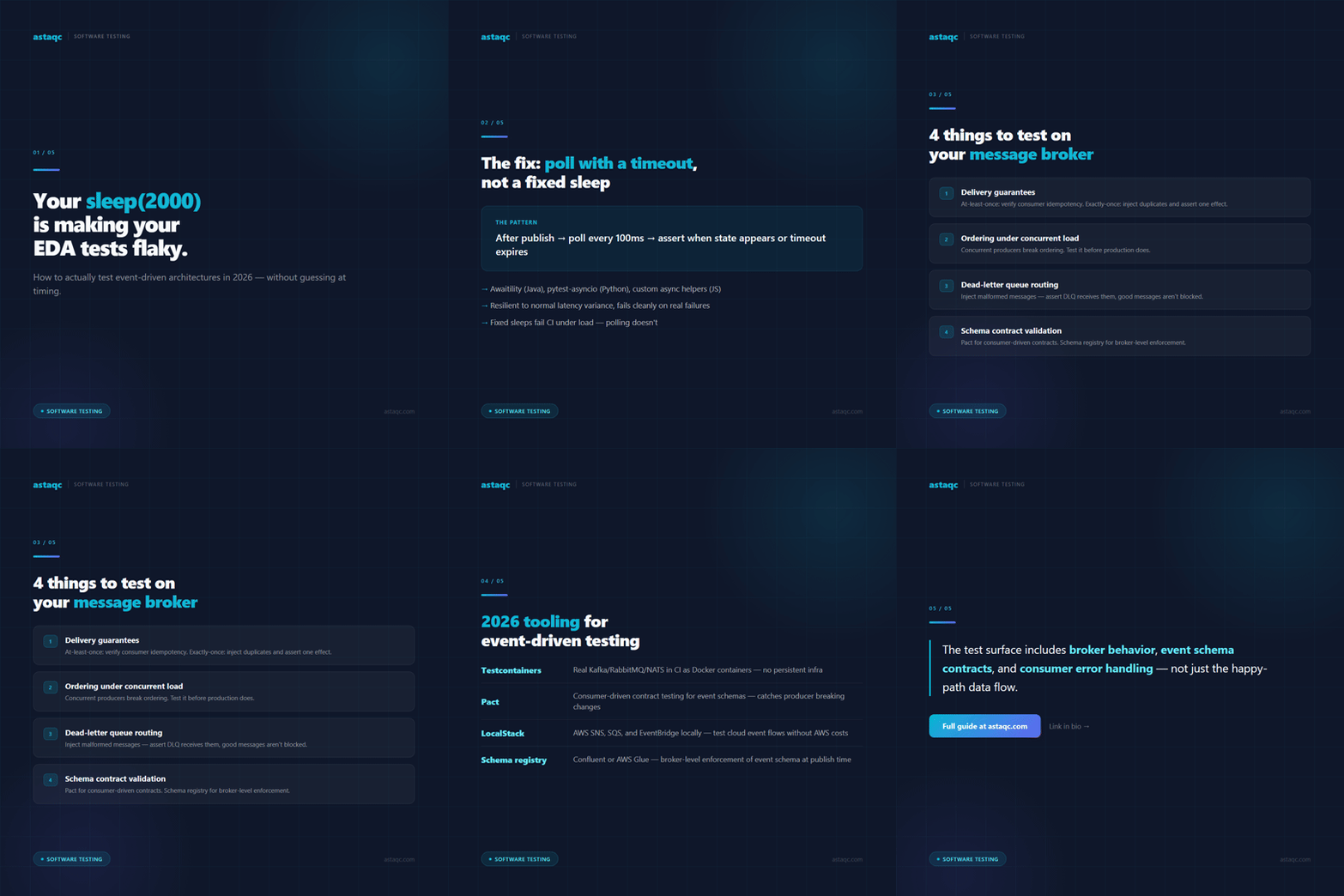
The test surface in an event-driven system includes the broker behavior, the event schema contract, and the consumer’s handling logic under both normal and failure conditions—not just the happy-path data flow.
August 31, 2026


Sign up to receive and connect to our newsletter

We founded ASTAQC as a tight-knit group of professional Software Testers and software developers.
Subscribe to our Newsletter