September 13, 2026
AI in test automation in 2026 delivers measurable value in three specific areas: generating test steps from natural language descriptions, updating broken selectors when UI changes break existing tests, and prioritizing which tests to run based on code change analysis. Outside these areas, the limitations are substantial. AI-generated tests require human review to verify that assertions actually test the intended behavior. AI cannot determine what level of test coverage is appropriate for a given risk level. And AI-powered test generation does not eliminate the need for a test strategy—it accelerates execution of a strategy you still need to design. Teams that treat AI as a generation and maintenance accelerator get real productivity improvements. Teams that delegate testing decisions to AI accumulate coverage debt that surfaces in production.
The gap between expectation and reality is wider in testing than in code generation. In code generation, a developer can read AI output and assess whether it is correct. In test generation, a QA engineer needs to assess not just whether the test code is syntactically correct but whether it actually validates the behavior the application is supposed to produce—a more difficult judgment that requires domain knowledge about the feature and the failure modes. This is why teams that invest in AI test automation without also investing in test design skills and review processes see smaller gains than teams that use AI to accelerate a human-led testing workflow. Astaqc’s test automation services work with teams to build both the tooling and the review process around AI-assisted testing.
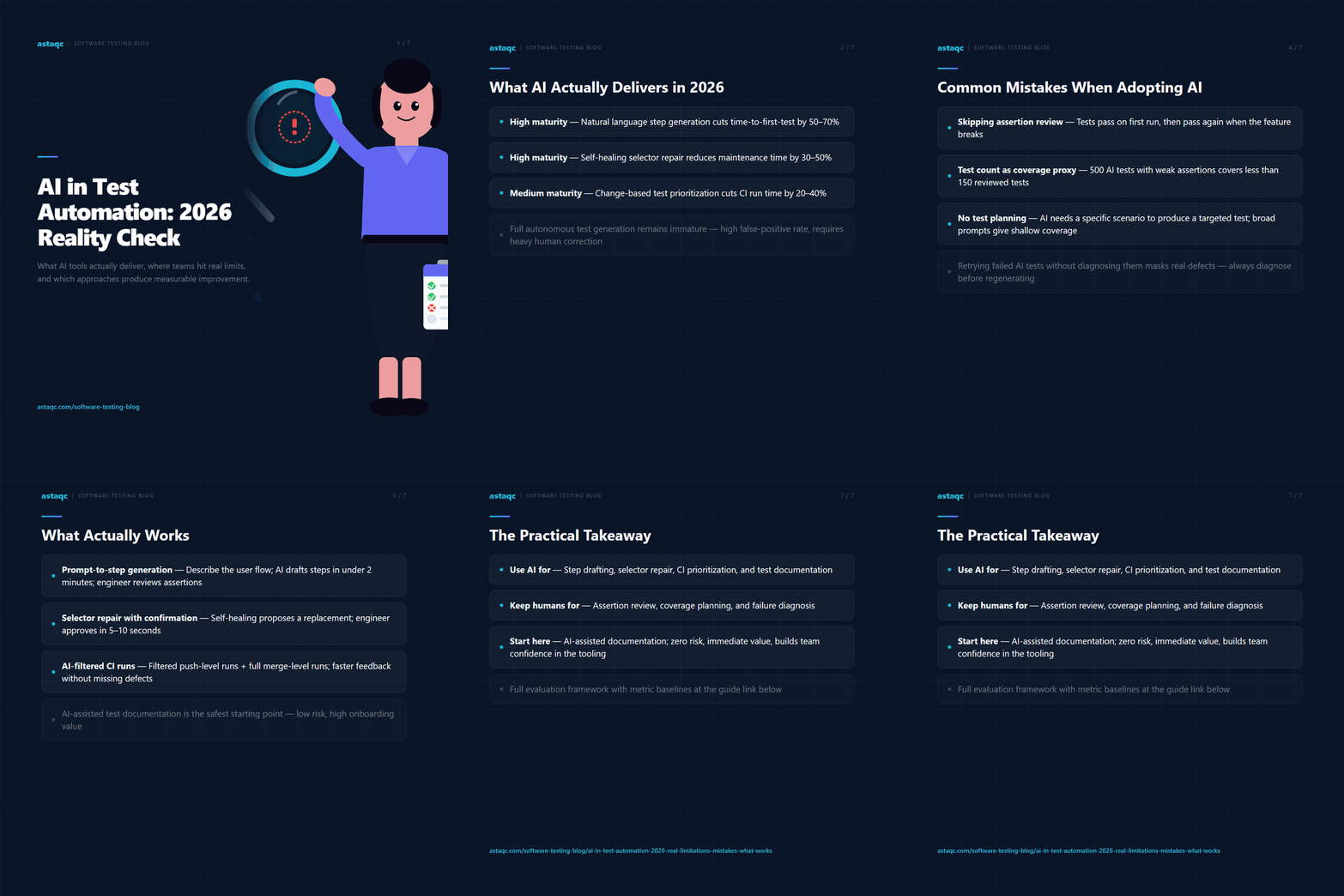
AI contributions to test automation in 2026 fall into four categories based on maturity and demonstrated ROI across teams:
| AI Capability | Maturity Level | Realistic Gain |
|---|---|---|
| Natural language step generation | High | 50–70% reduction in time-to-first-test for new scenarios |
| Self-healing selector repair | High | 30–50% reduction in maintenance time for stable test suites |
| Test impact analysis (change-based prioritization) | Medium | 20–40% reduction in CI run time with equivalent defect detection |
| Full autonomous test generation (end-to-end coverage) | Low | High false-positive rate; requires significant human correction |
The data on time-to-first-test reduction is the most consistent finding across teams that have adopted AI step generation. Creating the first version of a test—describing the scenario, setting up actions and assertions—takes substantially less time when an AI model can draft the step sequence from a prompt. The bottleneck shifts from writing steps to reviewing and correcting the AI output, which is faster but not zero. The full-autonomous case remains immature: AI-generated tests that are never reviewed catch some real defects but also produce a class of false positives and missed assertions that erode trust in the test suite over time. Astaqc’s guide to AI in software testing covers the full landscape of where AI adds value across the testing lifecycle.
The limitations of AI in test automation are not hypothetical. They surface in specific scenarios that teams encounter within the first few months of adoption.
Assertion accuracy. AI-generated tests frequently produce assertions that are syntactically valid but semantically incorrect—checking that a value exists rather than that it equals the expected value, or asserting on a UI element that reflects a cached state rather than the current application state. These tests pass when the feature is broken and fail when the feature is correct, which is worse than no test. Human review of AI-generated assertions is not optional—it is the step that determines whether the test provides real coverage or false confidence.
Test isolation assumptions. AI models generate tests that assume clean state at the start of each run. In practice, tests share environment state through databases, sessions, and cached data. AI-generated tests do not include state cleanup steps unless the engineer explicitly instructs them to, which means test suites generated primarily by AI accumulate isolation problems that cause intermittent failures. These failures are often attributed to flakiness rather than to missing setup and teardown logic, which delays the diagnosis.
Non-deterministic generation. Running the same AI prompt twice produces different test structures. This makes it difficult to maintain consistency across a large test suite where different engineers generated tests at different times. Without a review process that enforces a consistent step format and assertion style, AI-generated suites become harder to read and audit than hand-written suites.
Coverage judgment. AI tools can tell you how many steps a test contains, but they cannot tell you whether the test covers the right risk surface for the feature. Risk-based coverage decisions—which scenarios to test, which failure modes matter most, how deeply to test edge cases—require domain knowledge about the application and the business impact of different failure types. AI cannot substitute for that judgment. Teams that delegate coverage planning to AI see a version of the coverage paradox: high test counts with low defect detection rates.
These limitations apply across platforms—no-code AI tools, code-generating AI tools, and AI-augmented frameworks all share them to varying degrees. Understanding which limitations apply most to your team’s context is the starting point for designing an AI testing workflow that avoids them. For a framework evaluation, see the manual testing vs. automated testing guide.
The most common mistakes are predictable from the limitations above, but they are still widespread because the adoption pressure for AI tooling is high and the evaluation cycles are short.
Each of these mistakes is avoidable with a review process designed for AI-generated tests. The investment in that process—training engineers to review AI output critically, maintaining a checklist, tracking which tests were generated vs. hand-written—pays for itself quickly once the suite reaches a size where coverage confusion starts delaying releases. Astaqc’s manual testing services team works with QA engineers to build review checklists and test design skills that complement AI tooling rather than being replaced by it.
The approaches that produce consistent, measurable improvements share a common pattern: they use AI for the task where AI is fast and accurate (generating first drafts of steps, updating selectors, prioritizing runs) and keep humans responsible for the judgments that require domain knowledge (what to test, whether an assertion is correct, when coverage is sufficient).
Prompt-to-step generation for new features. For a feature that does not yet have test coverage, an AI chat interface can produce a complete step sequence from a description of the user flow in under two minutes. The engineer reviews the steps, corrects assertion values, adds edge case scenarios the AI did not include, and confirms the test. This workflow is significantly faster than writing steps from scratch while preserving engineer judgment over the final test structure.
Automated selector repair with manual confirmation. Self-healing mechanisms that propose a selector replacement and wait for engineer confirmation produce better outcomes than automatic repair. The manual confirmation step takes five to ten seconds per repair but creates an audit trail of what changed, prevents silent test corruption when the AI selects the wrong replacement, and keeps engineers aware of what the application’s DOM structure is doing across releases.
CI trigger with AI-filtered test selection. Running the full test suite on every CI push is slow. AI change-impact analysis—running only the tests likely to be affected by a code change—cuts CI feedback time without reducing defect detection in most change classes. The filter is not perfect, so a full suite run on merge to the main branch catches what the filtered run missed. The combination of filtered push-level runs and full merge-level runs is the most practical implementation.
AI-assisted test documentation. AI tools are effective at generating plain-language descriptions of what a test does from its step sequence. This is useful for test suite documentation, for onboarding new engineers, and for compliance reviews that require human-readable test descriptions. It is low-risk because the documentation does not affect test execution. This makes it a safe starting point for teams building AI tooling confidence. See the complete guide to software testing for a framework to decide where AI assistance fits in a comprehensive testing program.
The right metrics for AI test automation are different from the right metrics for traditional test automation. Coverage percentage and test count are not useful if the AI is generating shallow tests. The metrics that indicate real improvement are defect detection rate (what fraction of production defects were caught by tests before release), test maintenance time (hours spent per sprint fixing broken tests), and time-to-first-test for new features (how long after a feature is merged does it have automated test coverage).
A practical evaluation framework runs for six to eight weeks: baseline the three metrics above, introduce the AI tooling for new test creation and maintenance, and re-measure at the end. If defect detection rate is flat or declining while test count is growing, the AI-generated tests are not catching the right failures. If test maintenance time is not declining, the self-healing is not working well for your test suite’s selector patterns. If time-to-first-test is not declining, the AI generation workflow is not reducing the creation bottleneck. Astaqc’s software testing services include baseline assessments that establish these metrics before tooling changes are introduced.
No. AI-generated tests cover documented, predictable scenarios. Manual exploratory testing covers undocumented edge cases, unexpected user behaviors, and failure modes that are not obvious from the feature specification. The two approaches cover different risk surfaces. Teams that eliminate manual testing in favor of AI-generated suites see a specific class of defect—failure modes discoverable only through exploratory testing—that reaches production undetected. A practical target in 2026 is to reduce manual regression testing while maintaining structured exploratory testing for new features.
The primary risk is false confidence: a test suite that passes consistently but is not actually testing the application behavior that matters. Unreviewed AI-generated tests tend to assert on surface properties—element presence, page title, status code—rather than on the application state that proves a feature works correctly. A regression in core business logic can pass through an unreviewed AI-generated suite undetected if the surface properties the test checks remain unchanged.
The most effective approach is a test design standard that specifies assertion patterns, naming conventions, and step granularity, combined with a review checklist applied to all new tests regardless of whether they were AI-generated or hand-written. Teams that standardize on a step format—what an action step looks like, how assertions are phrased, what cleanup steps are required—get a consistent suite even when AI generates the initial draft and multiple engineers do the reviewing.
No. Self-healing handles the most common maintenance scenario: a UI element’s selector attribute changes without the element’s behavior changing. It does not handle cases where the application behavior itself changes, where a feature is removed, or where a test was asserting on incorrect behavior from the start. Teams with active development pipelines typically see self-healing reduce maintenance by 30–50% rather than eliminate it. The remaining maintenance requires human judgment about whether a test failure represents a real defect or a test that needs to be updated to reflect intentional behavior changes.
Teams in regulated industries with mandatory audit trails—healthcare, financial services, insurance—need to ensure that every test assertion can be traced to a documented requirement. AI-generated assertions that are not reviewed against requirements documentation fail this traceability check. These teams can use AI for step generation and selector maintenance but need a more formal review process before committing tests to the auditable suite. Astaqc’s testing documentation services help regulated-industry teams build traceability into AI-assisted testing workflows.
AI generates tests faster than humans write them. Humans verify that those tests actually check the right things. Neither step is optional if the goal is test coverage that catches production defects.
September 13, 2026


Sign up to receive and connect to our newsletter

We founded ASTAQC as a tight-knit group of professional Software Testers and software developers.
Subscribe to our Newsletter



.png)